Company overview
Scimplify is a Bengaluru-based specialty chemicals and advanced materials company founded in 2023 by Sachin Santhosh, Salil Srivastava and Dheeraj Dhingra. The company combines in-house scientific development with a distributed manufacturing network, allowing customers to move from a molecule or material requirement to commercial production without separately coordinating research laboratories, process-development teams and manufacturing plants.
Scimplify describes itself as a science-first manufacturing company rather than a chemicals marketplace. That distinction is important. The company takes responsibility for process development, scale-up, sourcing and delivery, while using hundreds of manufacturing partners rather than owning all the production capacity itself.
Why the Model Exists
Specialty chemicals are difficult to source because technical specifications matter as much as price. A buyer may find a factory that can theoretically make a molecule, but still face questions around purity, yield, process safety, regulatory documentation, scale-up and delivery consistency.
Scimplify was created around that gap. Its founders had experience in industrial sourcing, manufacturing and technology businesses and saw that global customers often struggled to identify Indian suppliers that could reliably move from laboratory chemistry to repeated commercial production.
The company therefore positions itself between traditional contract research, contract manufacturing and chemical distribution. It attempts to provide one accountable interface across all three.
From Molecule to Commercial Scale
Scimplify’s process begins with the customer requirement. That may involve an existing specialty chemical, a new material, a process that needs to be localised or a product currently dependent on a concentrated international supply chain.
Its internal R&D team works on synthesis routes, analytical methods, process optimisation and scale-up. Once the chemistry is mature enough, the company allocates production to manufacturing partners with the right reactors, equipment, certifications and cost structure.
This lets Scimplify stay relatively asset-light while still controlling the scientific and commercial relationship with the customer.
A Distributed Manufacturing Network
The company says it works with more than 500 manufacturing partners and thousands of scientists and technical partners. That network gives it access to different equipment configurations and chemistry capabilities without requiring Scimplify to build a large multipurpose plant for every product category.
The advantage is flexibility. A pharmaceutical intermediate may need very different infrastructure from a semiconductor material or a crop-science chemical.
The difficulty is quality control. A distributed network only works if Scimplify can enforce consistent specifications, documentation and operating standards across independent factories.
Advanced Materials Beyond Traditional Specialty Chemicals
Scimplify began with strong exposure to life sciences, crop sciences and industrial chemicals, but it has been expanding into advanced materials for energy, semiconductors, defence and other strategic sectors.
That shift broadens the company from being primarily a specialty-chemicals sourcing platform into a materials company serving industries where supply security can be strategically important.
Semiconductor chemicals, battery materials and rare-earth-related products can have far stricter purity requirements than ordinary industrial chemicals. Entering these categories requires deeper analytical capabilities and more demanding process control.
Technology and AI
Scimplify increasingly uses software and AI to support its scientific and manufacturing workflows. The objective is not to automate chemistry completely but to make molecule selection, route development, supplier matching and process learning more data-driven.
The company can accumulate information across experiments, plants and customer programmes. Over time, that dataset can help identify which synthetic routes are likely to scale, which plants are suited to particular chemistry and where process risk is likely to emerge.
This is one of the ways Scimplify can become more than a trading business. The underlying knowledge base becomes more valuable as the company handles a larger number of programmes.
Global Expansion
Scimplify has expanded internationally from an early stage. Its current public material says it operates offices and teams across five countries, serves more than 1,000 innovator customers and works across more than 30 countries.
The company has established presence in markets including the United States, the UAE and Indonesia while maintaining its main R&D and operating base in India.
The global opportunity is tied to supply-chain diversification. Pharmaceutical, semiconductor, energy and industrial companies are increasingly looking for alternatives to concentrated sourcing from China. India has manufacturing capacity, but international customers often need help identifying, qualifying and managing suppliers.
Scimplify is trying to become that layer.
Funding and Scale
In March 2025, Scimplify raised a $40 million Series B co-led by Accel and Bertelsmann India Investments. That round followed earlier seed and Series A funding and brought total funding to roughly $54 million at the time.
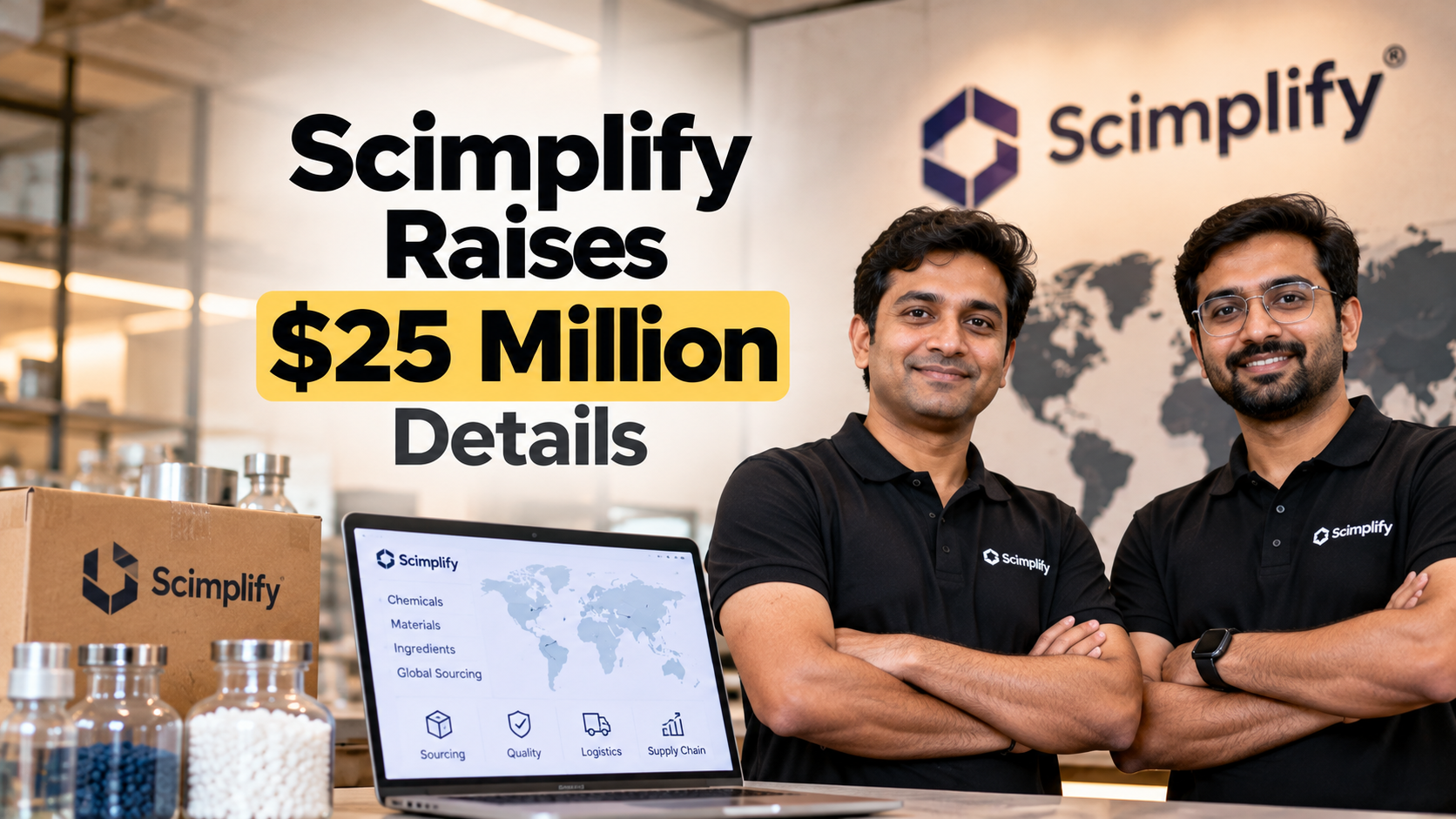
In October 2026, the company raised another $25 million strategic round led by Hitachi Ventures, with customers Henkel and Teknor Apex participating alongside existing investors. The company said the latest capital would support its expansion into advanced materials and critical supply chains.
The participation of customers as investors is notable because it suggests strategic interest from industrial buyers rather than only financial investors.
Why the Founders’ Backgrounds Matter
Sachin Santhosh previously worked across companies including Bizongo and OfBusiness and had already attempted entrepreneurship before Scimplify. Salil Srivastava and Dheeraj Dhingra brought experience from industrial companies including Zetwerk and ITC.
That mix matters because Scimplify’s challenge is not only scientific. It has to combine R&D with procurement, plant selection, commercial negotiation, international sales and operational execution.
The founders came from businesses that had already tried to organise fragmented industrial supply chains, which made the move into specialty chemicals a logical extension rather than a completely new operating model.
The Core Business Model
Scimplify earns by delivering chemicals and materials to customers, not by charging only for introductions between buyers and plants. That means it takes commercial responsibility for the product and coordinates the underlying manufacturing network.
Its margins therefore depend on its ability to design efficient processes, negotiate production economics, choose the right manufacturing partner and maintain quality.
The model can be attractive if Scimplify’s scientific work creates better yields or lower costs than a customer could achieve through a conventional trader or contract manufacturer.
The Main Risk
The company’s biggest strength is also its largest operational risk. It can scale without owning every plant, but it remains responsible for what those plants produce.
A quality failure, delayed batch or scale-up problem can damage the customer relationship even when the physical manufacturing happened at a partner site. As Scimplify enters semiconductors and advanced materials, the tolerance for inconsistency becomes even lower.
The company therefore has to build strong process-transfer, audit and analytical systems around its manufacturing network.
What Scimplify Is Today
Scimplify has evolved rapidly from a young specialty-chemicals startup into a broader advanced-materials manufacturing platform with global customers and substantial institutional funding.
Its central thesis is that India can become a major supplier of sophisticated chemicals and materials, but global customers need more than access to factories. They need a partner that can understand the chemistry, scale the process and remain accountable for delivery.
If Scimplify can maintain that scientific and operational depth while expanding across hundreds of products and manufacturing partners, it can become an important bridge between India’s fragmented chemical capacity and global advanced-material demand.