Scimplify Raises $25 Million: Why India’s Specialty Chemicals Story Is Getting Bigger
What's covered
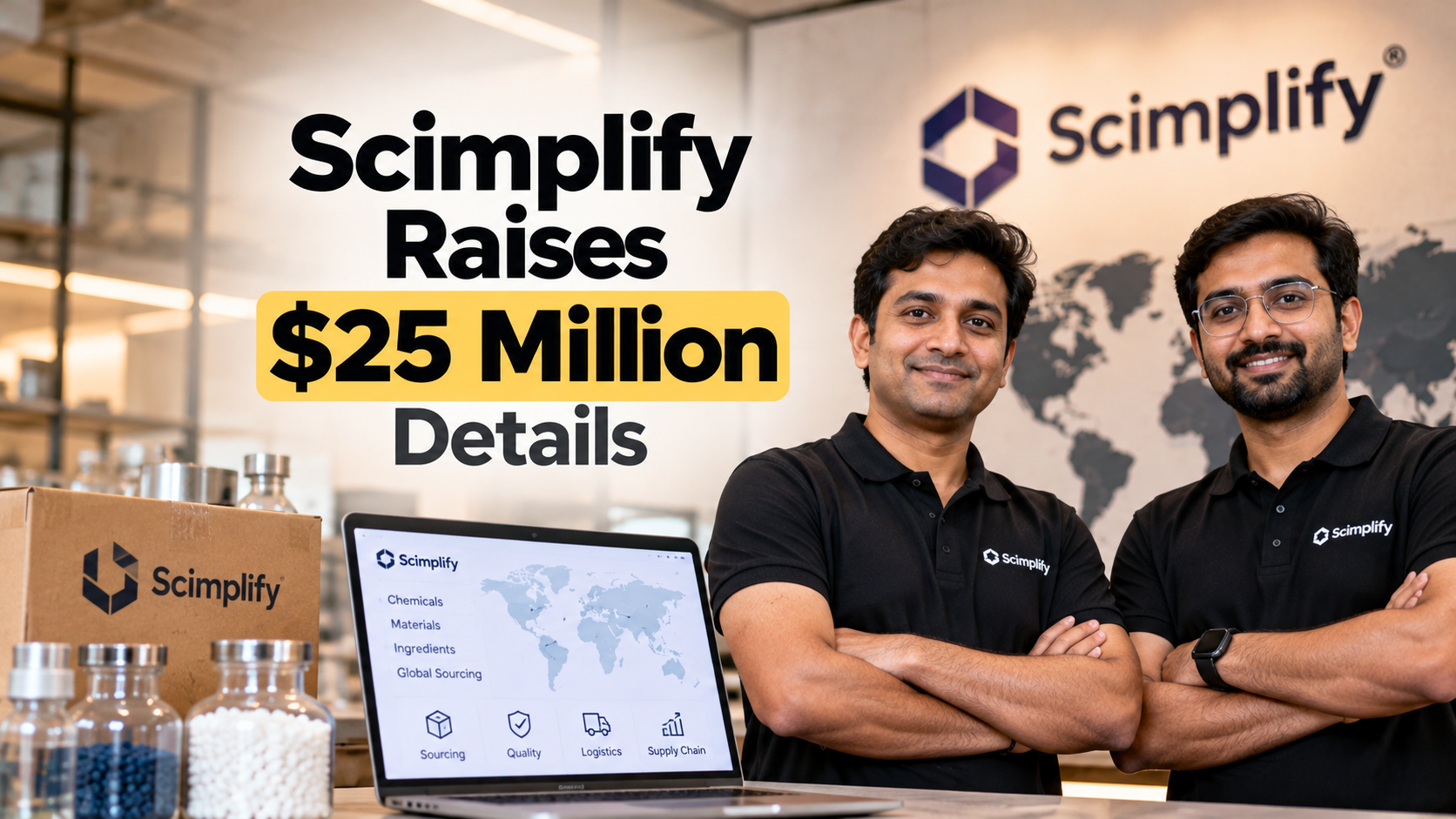
Bengaluru-based Scimplify has raised $25 million in a funding round led by Hitachi Ventures to expand its speciality chemicals and advanced materials business. The investment comes as global manufacturers look for alternatives to China for critical materials used in semiconductors, batteries, defence and energy.
The round also saw participation from Henkel, Teknor Apex and existing investors including Accel, 3one4 Capital, Bertelsmann India Investments and Omnivore. With this investment, Scimplify's total equity funding has reached $80 million.
What Does Scimplify Do?
Founded in 2023, Scimplify helps companies develop and manufacture speciality chemicals and advanced materials. These are materials designed for specific industrial uses, often requiring high purity and strict quality standards.
Developing such materials can be expensive and time-consuming. Companies need research facilities, technical expertise and manufacturing capacity before they can produce them commercially.
Scimplify simplifies this process by handling chemical research and development before moving production to its network of more than 500 manufacturing facilities.
Its AI platform, SciNode, helps identify suitable production methods, select manufacturing partners and monitor quality requirements. According to co-founder Sachin Santhosh, the company has completed certain projects in just two months, compared with the 12 to 18 months such work typically requires.
How Fast Is Scimplify Growing?
Scimplify has reached an annualised revenue run rate of approximately $200 million, nearly three times its level a year earlier. This means its current business activity would translate into roughly $200 million in annual revenue if sustained, rather than representing revenue already earned over a full year.
The company now serves more than 1,000 customers and has supplied products to over 40 countries.
Its international business has also expanded rapidly. Customers outside India contribute more than half its revenue, compared with less than 5% around 18 months ago. The US alone accounts for approximately 30% of its business, with an annualised revenue run rate of $60 million.
Energy, electronics and defence now generate around 45% to 50% of Scimplify's revenue, up from less than 15% a year ago. This reflects its growing focus on higher-value industrial materials.
Why Is Hitachi Ventures Investing in Scimplify?
The investment reflects a broader change in global manufacturing. China remains a major supplier of several critical materials, but companies are increasingly looking to diversify their sourcing to reduce supply chain risks.
Scimplify is positioning itself as an alternative by combining Indian manufacturing capacity with chemical research and AI-driven production planning.
An important aspect of the funding round is that investors such as Hitachi, Henkel and Teknor Apex are also Scimplify customers. Their participation suggests that the company is attracting interest from businesses that understand its manufacturing capabilities firsthand.
Scimplify also works with companies including BASF and Japanese electronics manufacturer TDK.
What Will Scimplify Do With the Funding?
The company plans to strengthen its research capabilities, expand internationally and further develop SciNode.
Around $7.5 million is expected to support its US expansion, including building a larger manufacturing network. Another $2 million has been earmarked for developing its AI platform.
Currently, approximately 90% of Scimplify's manufacturing takes place in India. However, the company plans to expand its production network into the US and Japan, allowing it to serve international customers more closely.
Why This Matters for India's Specialty Chemicals Industry
India has an opportunity to become a more important supplier of speciality chemicals as global companies diversify their manufacturing networks.
However, replacing established suppliers involves more than offering lower production costs. Manufacturers must demonstrate consistent quality, meet technical standards and deliver specialised materials at commercial scale.
Scimplify's approach addresses these challenges by connecting research, technology and manufacturing through a single platform.
Its growth also shows how demand is shifting towards materials used in high-value industries such as semiconductors, energy and defence.
The bigger opportunity for Scimplify is not simply manufacturing chemicals in India, but helping global companies develop reliable alternative supply chains. Its reported $200 million annualised revenue run rate suggests meaningful demand, although sustaining that growth will depend on its ability to maintain quality, expand manufacturing capacity and deliver profitably.
For India's speciality chemicals industry, Scimplify offers an example of how research-led manufacturing could help the country move beyond being a lower-cost production destination and become a supplier of more technically demanding materials.