Company overview
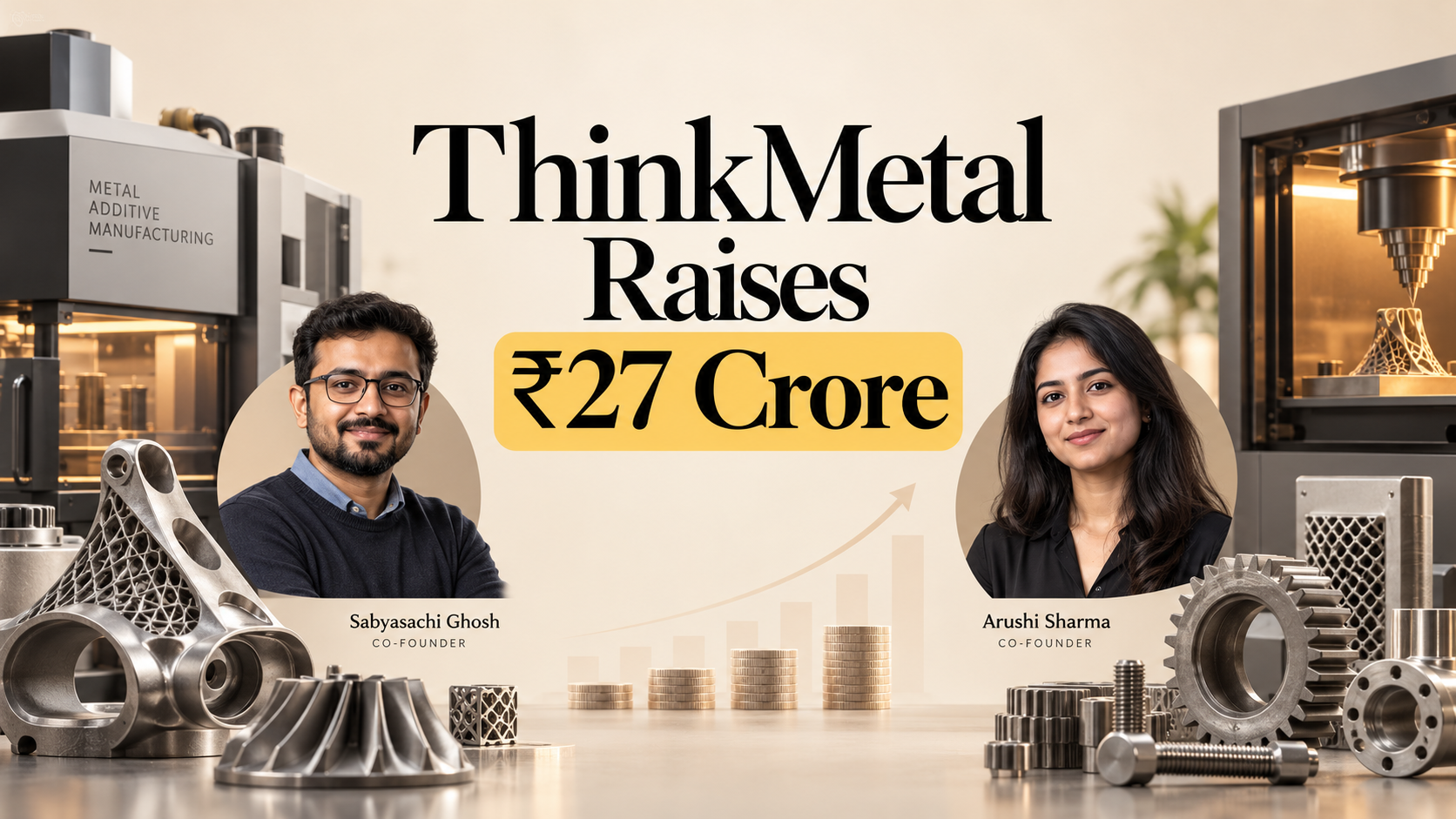
ThinkMetal is a Chennai-based advanced manufacturing company founded in 2021 by Sabyasachi Ghosh and Arushi Sharma. The company develops industrial metal additive-manufacturing systems designed to let manufacturers produce metal tooling, prototypes and functional components more quickly and with less dependence on large imported machines.
The founders met through engineering projects, including the SpaceX Hyperloop Pod Competition, before working in the 3D-printing ecosystem. Their experience led to a specific problem statement: metal additive manufacturing was technically powerful but often too expensive, large and operationally complex for many Indian manufacturers to adopt inside their own facilities.
The Problem With Conventional Metal 3D Printing
Industrial metal additive manufacturing has traditionally relied on expensive systems such as laser powder-bed fusion. These machines can make complex parts that are difficult to produce through conventional machining, but the equipment, powders, inert-gas requirements and operating skills can put the technology beyond the reach of smaller manufacturers.
ThinkMetal’s thesis is that many factories do not need the most expensive additive platform. Toolmakers, prototyping shops and industrial manufacturers often need a practical way to make jigs, fixtures, dies, mould inserts and low-volume metal parts quickly.
The company is therefore trying to make metal additive manufacturing easier to deploy inside existing manufacturing environments rather than only in specialised additive-manufacturing centres.
SistemT1 and the Product Approach
ThinkMetal’s core system is the SistemT1, a compact metal 3D-printing platform built around the company’s proprietary process and materials. Instead of printing directly with loose metal powder through a high-power laser, the system uses a multi-stage approach in which a printable feedstock is shaped and then processed to achieve the final metal part.
This architecture can reduce equipment complexity and make the system more accessible to manufacturers that already understand conventional furnaces and workshop processes.
The company sells more than the printer itself. Its product stack includes software, proprietary FuseX materials and thermal-processing equipment, creating an end-to-end workflow from digital part file to finished metal component.
The Founders
Sabyasachi Ghosh is Co-Founder and Chief Executive Officer. His background includes mechanical design, product development and previous work in the 3D-printing industry. Arushi Sharma is Co-Founder and Chief Technology Officer and brings materials, engineering and R&D expertise.
Their partnership is important because additive manufacturing sits between hardware, materials science and process engineering. A printer can be mechanically sound but still fail if the feedstock, furnace profile or material shrinkage is not controlled properly.
ThinkMetal therefore has to develop the machine and the process as one system rather than treating hardware and materials as separate businesses.
Proprietary Materials
The company’s FuseX materials are an important part of its differentiation. In metal additive manufacturing, the feedstock has to print consistently and then survive debinding and sintering without unacceptable distortion, porosity or dimensional error.
ThinkMetal has said its materials are backed by patented research and development. This matters because a compact printer is easier for competitors to reproduce than a validated material-and-process system that delivers repeatable mechanical properties.
The material layer can also create recurring revenue because customers need compatible feedstock as they continue using the installed equipment.
Target Customers
ThinkMetal is focused on B2B manufacturing customers, particularly toolmakers, prototype manufacturers and suppliers serving automotive, aerospace, defence and industrial OEMs.
These customers frequently need small quantities of customised metal parts. Conventional CNC machining can be slow or expensive when geometries are complex, and outsourcing additive manufacturing introduces lead times and confidentiality concerns.
An in-house system can be attractive if the economics are strong enough and the machine is simple enough to operate without a large specialist team.
Building Indigenous Manufacturing Technology
The company positions itself as an Indian alternative in a market where advanced additive-manufacturing equipment has historically been imported. That positioning has become more relevant as aerospace, defence and industrial customers seek local supply chains and domestic engineering capability.
ThinkMetal’s challenge is not simply to prove that its machine can print metal. Customers need repeatability, dimensional accuracy, material certification and service support. Industrial adoption is therefore slower and more demanding than selling a conventional desktop 3D printer.
Funding and the Next Stage
ThinkMetal raised early capital from investors including 100X.VC and later institutional investors. In October 2026, reporting said the company raised about ₹27 crore in a round led by IAN Alpha Fund with participation from other investors.
The new capital is intended to support growth, manufacturing technology and commercial expansion. This moves the company into a different phase: it must convert technical credibility into installed machines and repeat industrial customers.
What ThinkMetal Is Trying to Become
ThinkMetal’s larger opportunity is to build a domestic industrial-additive ecosystem rather than a single machine. If its printer, software, proprietary materials and post-processing workflow operate reliably together, the company can become a manufacturing-technology platform for factories that want metal additive capability without buying a large imported system.
The difficult part is industrial trust. A manufacturer may test a new printer on prototypes, but critical production parts require long validation cycles. ThinkMetal’s future therefore depends on proving repeatability across real customer applications, not only on demonstrating that the underlying technology works.