GIVA Raises ₹975 Crore: Why It Plans to Expand From 425 to 1,000 Stores
What's covered
GIVA, the Bengaluru-based jewellery brand, has raised approximately ₹975 crore ($102 million) in a funding round led by Multiples Alternate Asset Management. The investment comes as the company plans to more than double its store network and expand beyond its original silver jewellery business into gold and lab-grown diamonds.
Founded in 2019, GIVA has grown into a business generating approximately ₹865 crore in annual revenue. However, its next phase of growth will depend on whether it can expand its physical presence while improving profitability.
GIVA's ₹975 Crore Funding Round Explained
The funding round, announced on 3 November 2026, was led by Multiples Alternate Asset Management, with participation from existing investors Epiq Capital and Edelweiss Discovery Fund.
The ₹975 crore transaction includes both primary and secondary investments. Primary capital goes directly to GIVA to support its business, while secondary transactions allow existing shareholders to sell part of their holdings.
Early investors India Quotient and Sixth Sense Ventures have partially sold their stakes. The transaction also includes an employee stock option (ESOP) buyback worth approximately ₹20–25 crore.
Multiples will acquire a stake of more than 15% and receive a board seat, becoming one of GIVA's largest investors alongside Premji Invest.
GIVA has not disclosed its latest valuation, although founder and CEO Ishendra Agarwal confirmed that it is higher than the valuation achieved in its previous funding round. In June 2025, the company raised ₹530 crore at a reported valuation of approximately ₹4,800 crore.
The distinction between primary and secondary capital matters because the entire ₹975 crore will not be available for expansion. The company has not disclosed how much of the transaction represents fresh capital.
How Fast Has GIVA Grown?
GIVA started as a digital-first brand specialising in affordable sterling silver jewellery. It initially focused on everyday wear and gifting, selling through online channels before expanding into physical retail.
The company has since entered gold and lab-grown diamonds, while significantly expanding its distribution network.
Its revenue growth reflects that expansion.
| Financial Year | Revenue |
|---|---|
| FY24 | ₹273 crore |
| FY25 | ₹518 crore |
| FY26 | ₹865 crore |
Swipe sideways to view the full table.
Revenue increased by approximately 67% in FY26, following growth of nearly 90% in FY25. GIVA has also reported a compound annual growth rate exceeding 70% over the past three years.
However, revenue growth has not yet translated into overall profitability.
The company reported a net loss of ₹72.3 crore in FY25, compared with ₹58.6 crore in FY24. Its operating performance improved in FY26, with management reporting that its negative EBITDA margin had narrowed to single digits.
This suggests that GIVA is becoming more efficient as its business grows, although it has yet to demonstrate sustainable profitability.
Why GIVA Is Moving Beyond Silver Jewellery
One of GIVA's most significant changes is its shift from being primarily a silver jewellery brand to offering a wider range of fine jewellery.
Gold and lab-grown diamonds now contribute approximately 45% of total revenue. This is a substantial change for a business originally built around sterling silver.
The company has also introduced lightweight gold jewellery, including 9-karat and 14-karat products, to reach customers looking for more affordable alternatives to traditional high-purity gold jewellery.
Its 9-karat gold collection, launched around four months ago, already contributes approximately 25% of the company's gold jewellery sales.
The strategy addresses an important change in consumer demand. As gold prices rise, heavier jewellery becomes less affordable for many customers. Lower-carat and lightweight designs offer lower entry prices, although their actual affordability also depends on making charges and design.
For GIVA, expanding into gold and lab-grown diamonds creates opportunities to increase its average selling price and serve customers across different jewellery categories.
It also introduces new challenges. Gold requires significant inventory investment, while lab-grown diamond pricing and demand can affect margins. Expanding the product portfolio therefore increases the importance of inventory management and manufacturing efficiency.
Why GIVA Wants to Open 1,000 Stores
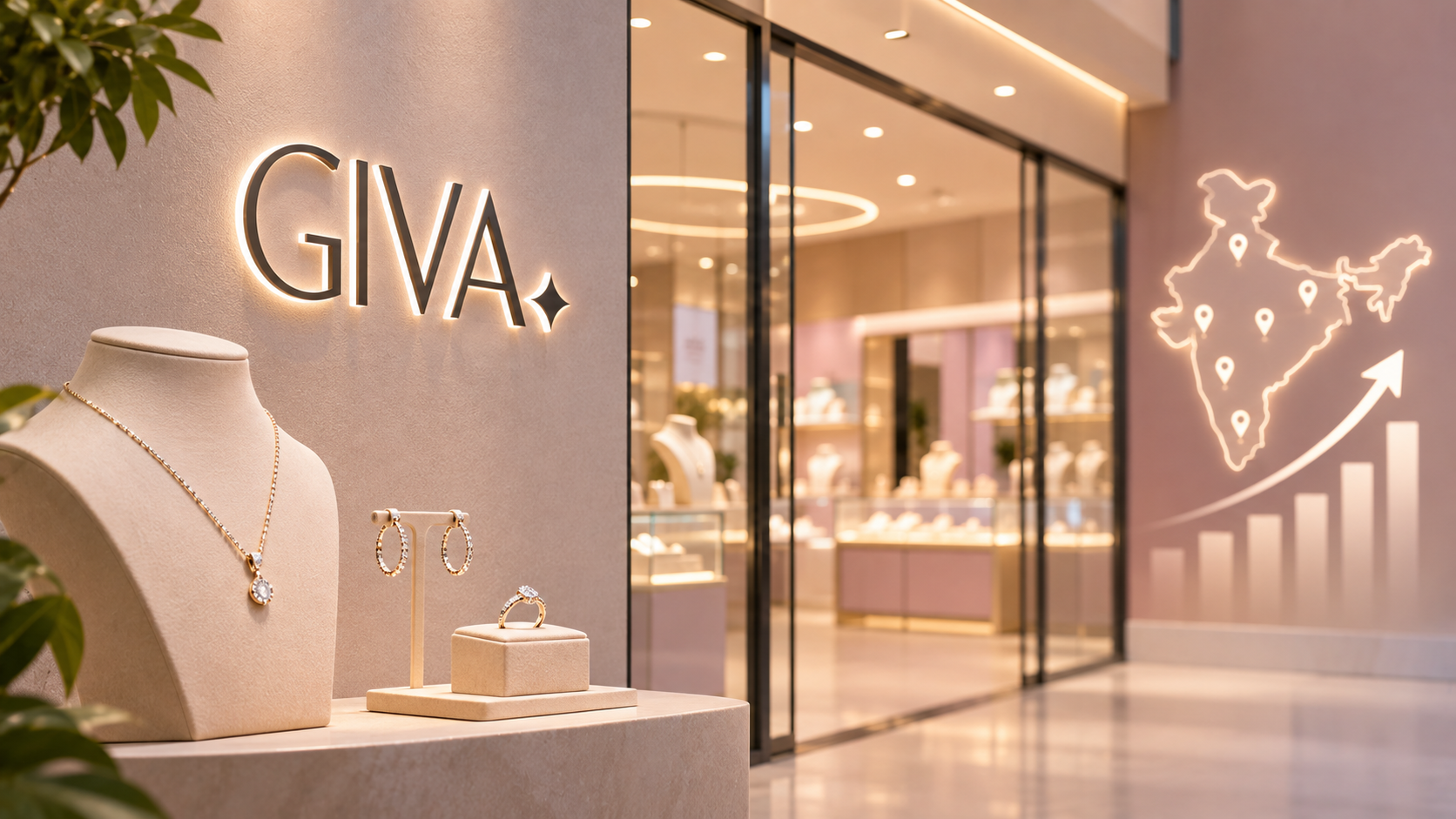
GIVA currently operates approximately 425 stores and aims to expand its network beyond 1,000 outlets over the next three to five years.
That means adding at least 575 stores, more than doubling its existing network.
Despite starting as an online-first business, physical retail has become central to GIVA's growth strategy.
Currently, around 55% of its revenue comes from digital channels, including its own website, app and online marketplaces. Physical stores contribute the remaining 45%.
Management expects the offline contribution to increase to approximately 75–80% over the next three years.
Jewellery is a category where physical stores offer important advantages. Customers can examine designs, assess product quality, try jewellery and receive assistance before making a purchase. Stores also support services such as alterations, repairs and plating.
For GIVA, physical retail can additionally help build trust in smaller cities where customers may be less familiar with newer jewellery brands.
The company is particularly focused on expanding into Tier II and Tier III markets, rather than prioritising international expansion.
However, opening stores does not automatically improve profitability. Each outlet requires investment in inventory, rent, employees and store operations.
The key question is whether new stores can generate enough sales to recover these costs within a reasonable period.
Management has indicated that stores operating for more than a year are profitable at the store level, with same-store sales growth helping absorb fixed expenses. This is encouraging, but store-level profitability is different from profitability for the company as a whole.
Where Will GIVA Invest the New Capital?
GIVA plans to deploy its fresh funding primarily towards retail expansion, manufacturing and working capital.
The company is looking to invest approximately ₹100 crore in strengthening manufacturing capabilities. Greater control over production, plating and finishing could help maintain product quality and shorten the time required to introduce new designs.
This becomes increasingly important as GIVA expands across silver, gold and lab-grown diamonds, each with different manufacturing and inventory requirements.
The company will also need to finance substantially more inventory as its store network expands.
Unlike many digital businesses, jewellery retail requires considerable working capital because stores must maintain enough designs and sizes to offer customers a meaningful selection.
Consequently, a growing store network can absorb significant cash even when revenue is rising.
The funding provides GIVA with additional resources to support expansion, but efficient inventory turnover and store productivity will determine how effectively that capital is used.
Can GIVA Become Profitable While Expanding?
GIVA's management is targeting profitability by FY28, but achieving this while opening hundreds of new stores will be challenging.
There are reasons for optimism. The company has increased revenue from ₹273 crore in FY24 to ₹865 crore in FY26, expanded into higher-priced jewellery categories and improved its reported operating margins.
A larger store network can also improve brand recognition, support repeat purchases and spread certain central costs over a bigger revenue base.
However, aggressive retail expansion creates three important financial pressures.
First, new stores take time to mature. Even if established stores are profitable, newly opened outlets can dilute overall margins during their initial operating periods.
Second, entering gold and lab-grown diamonds increases the capital tied up in inventory and exposes the company to changes in product demand and pricing.
Third, GIVA competes against established jewellery retailers such as CaratLane and BlueStone, making brand differentiation, customer acquisition costs and store productivity important.
The company will therefore need to balance revenue growth with disciplined capital allocation.
What GIVA's Next Phase of Growth Will Depend On
GIVA's latest funding marks a transition from a digital-first jewellery startup towards a large omnichannel retail business.
Its growth so far has been supported by expanding product categories, developing an offline presence and targeting demand for affordable everyday jewellery.
The next phase will be more capital-intensive.
Reaching 1,000 stores could substantially increase GIVA's market presence, but the number of outlets alone will not determine success. Revenue per store, same-store sales growth, inventory turnover and the conversion of revenue growth into positive cash flow will matter more.
GIVA has already demonstrated its ability to scale revenue rapidly. Its next challenge is proving that the growth can generate sustainable profits without requiring equally aggressive capital investment every few years.