Jio Case Study: 5 Strategies Behind Reliance Jio's Success
What's covered
- 1. Jio Built Its Network for Future Demand
- 2. Jio Changed the Economics of Mobile Data
- 3. Jio Prioritised Customer Acquisition Over Immediate Revenue
- 4. Jio Expanded the Market Instead of Just Taking Customers From Competitors
- 5. Reliance Used Its Financial Strength to Build a Long-Term Advantage
- The Results: From Subscriber Growth to Profitability
- From Free Internet to India's Largest IPO
- Why Jio's Strategy Is So Difficult to Replicate
In September 2016, Reliance Jio entered India's telecom market without an established commercial subscriber base. Airtel, Vodafone and Idea had already spent years building networks, distribution channels and customer relationships.
Ten years later, Jio had 54.24 crore customers, generated ₹30,049 crore in annual net profit in FY26 and joined India's most valuable listed companies. Its market value crossed ₹13 lakh crore on its stock market debut in October 2026.
Jio did not achieve this by simply offering cheaper internet. It changed the way telecom services were built, sold and consumed. Five strategies explain how it turned its position as a new entrant into an advantage.
1. Jio Built Its Network for Future Demand
Before Jio arrived, Indian telecom networks were largely built around voice calls and SMS. In 2015, wireless data cost an average of ₹226.30 per GB, and India had only around 13.2 crore mobile broadband subscribers at the end of FY16.
Reliance believed that high prices and limited access were holding back demand. Instead of building another traditional telecom network, Jio invested in a nationwide 4G network that could carry both internet traffic and voice calls using data technology.
Existing operators had to upgrade their networks while continuing to serve customers on older technologies. Jio could build around data from the beginning. By committing capital before demand materialised, it took a substantial risk, but also created the capacity needed to serve customers at much lower prices.
The advantage was not just having newer technology. Jio built its infrastructure for the market it expected to exist, rather than the market that existed in 2016.
2. Jio Changed the Economics of Mobile Data
With its network in place, Jio launched free introductory services and subsequently introduced affordable data plans with free domestic voice calls. It also simplified pricing: at launch, Jio offered fewer than 20 tariff plans in a market where operators collectively had more than 22,000.
The impact went far beyond Jio's own customers. India's average wireless data price fell from ₹226.30 per GB in 2015 to ₹19.35 in 2017 and ₹11.78 in 2018, a decline of nearly 95% over three years. Average monthly usage per wireless data subscriber rose from 4.13 GB in 2017 to 7.69 GB in 2018.
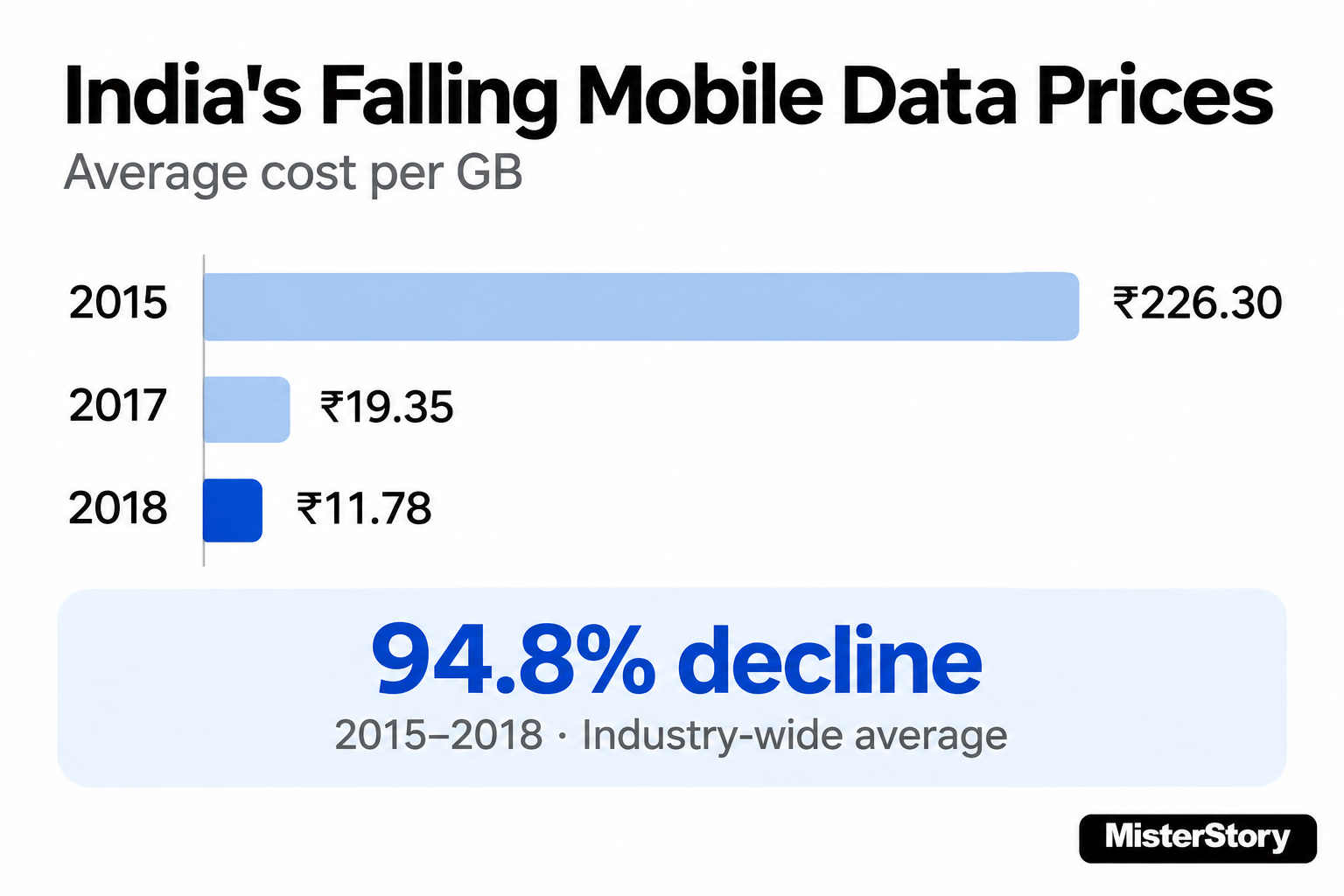
These industry-wide figures show how falling prices encouraged consumption. Affordable smartphones and growing demand for online services also contributed to this change.
For established operators, reducing prices threatened revenue from existing customers. Jio had no established voice or SMS revenue stream to protect. The same pricing decision therefore had very different financial consequences for Jio and its competitors.
3. Jio Prioritised Customer Acquisition Over Immediate Revenue
Telecom requires heavy upfront spending on spectrum, towers, fibre and equipment. Once a network has spare capacity, serving additional customers can cost relatively little compared with building that network, although additional traffic eventually requires further investment.
Jio used free introductory services to fill its network quickly. It acquired 10 crore subscribers in 170 days, an average of nearly 5.88 lakh subscribers a day.
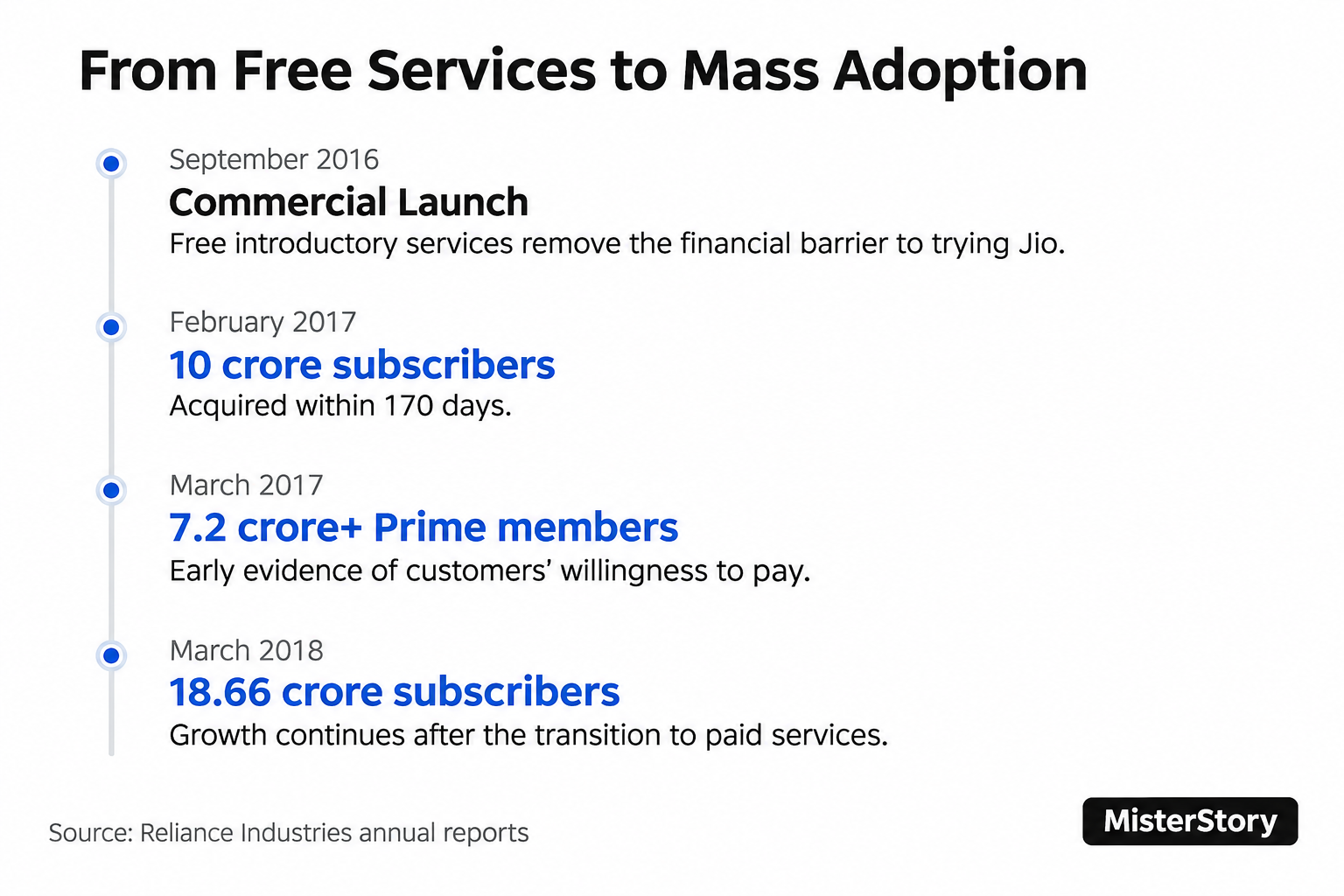
The harder test was getting customers to pay. By 31 March 2017, more than 7.2 crore customers had signed up for Jio Prime, its paid membership programme. By March 2018, the subscriber base had reached 18.66 crore.
Prime membership was not the same as a recurring paid subscription, but continued subscriber growth after the introduction of paid plans showed that demand extended beyond free trials. Free internet was a customer acquisition strategy, not Jio's long-term business model.
4. Jio Expanded the Market Instead of Just Taking Customers From Competitors
Cheap data alone could not solve another problem: Jio's network required compatible devices. In July 2017, India had around 78 crore mobile phones, of which approximately 50 crore were feature phones.
Jio introduced the 4G-enabled JioPhone with a refundable security deposit of ₹1,500, subject to return conditions. By FY22, the device had helped more than 10 crore 2G users move to 4G.
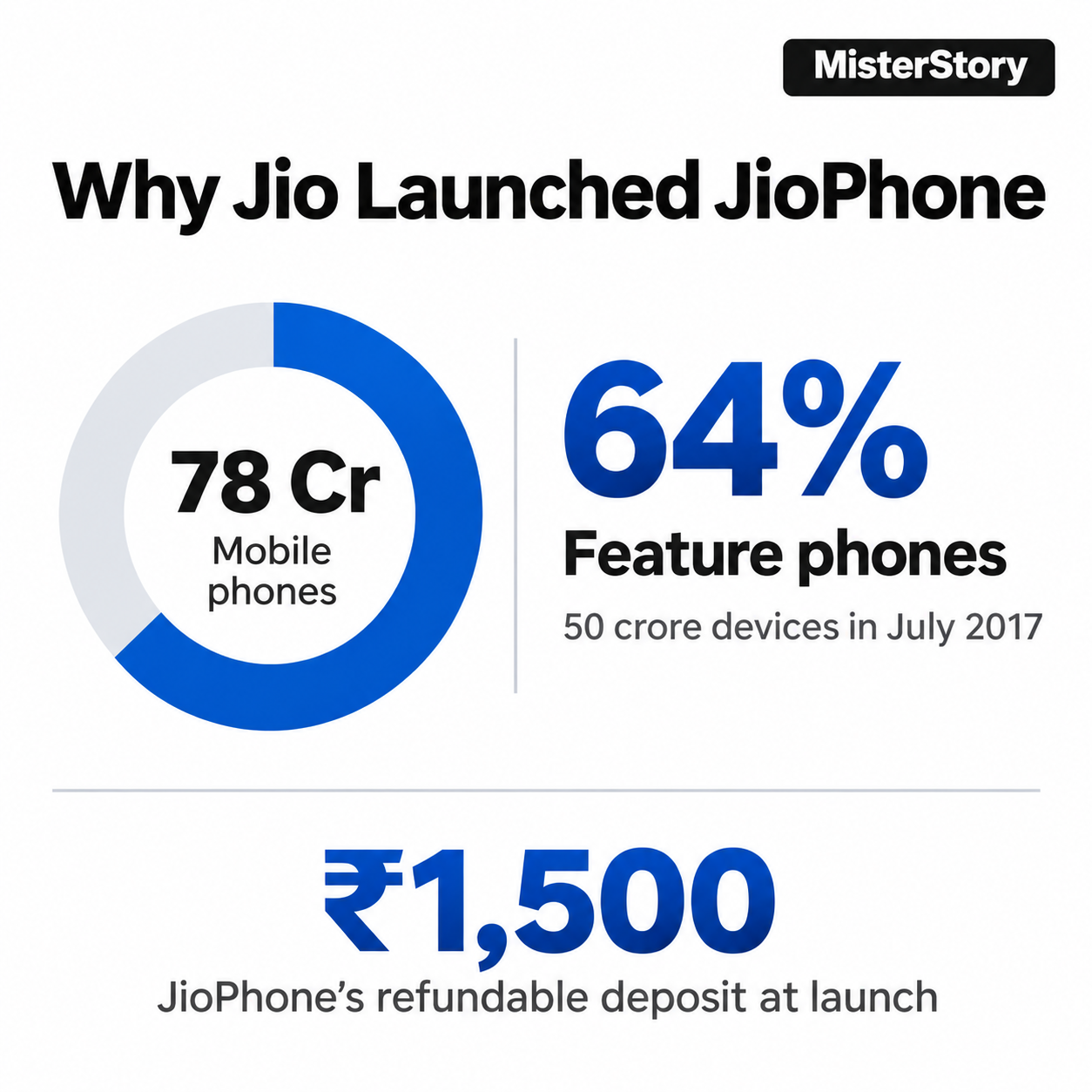
Instead of competing only for people who already owned smartphones, Jio lowered the cost of entering its network. The device also created an opportunity to earn recurring recharge revenue. Jio was expanding the market for its services, not merely dividing an existing market differently.
5. Reliance Used Its Financial Strength to Build a Long-Term Advantage
These strategies required a financial backer capable of funding years of investment. By FY21, Jio's cumulative investment since inception had exceeded $50 billion. Reliance's established businesses provided financial support, while its retail presence helped distribute SIM cards and devices.
Once Jio had demonstrated its ability to attract customers, it gained access to another source of capital. In 2020, Jio Platforms raised ₹1,52,056 crore from 13 investors, including Facebook and Google. By June 2020, Jio had 39.83 crore customers.
The sequence is important. Reliance initially accepted the risk of building the network and attracting users. External investors came in after the business had demonstrated scale, helping Reliance reduce group-level net debt and supporting the next stage of growth.
The Results: From Subscriber Growth to Profitability
Jio's subscriber base grew from 18.66 crore in March 2018 to 30.67 crore in March 2019, 48.18 crore in March 2024 and 54.24 crore in September 2026.
The financial results also changed rapidly. In the September 2017 quarter, Reliance Jio Infocomm generated ₹6,147 crore in operating revenue and reported a net loss of ₹271 crore. In the following quarter, it reported a net profit of ₹504 crore.
By FY26, the broader Jio Platforms business reported ₹1,46,885 crore in operating revenue, ₹76,255 crore in EBITDA and ₹30,049 crore in net profit. Its EBITDA margin was approximately 51.9%.
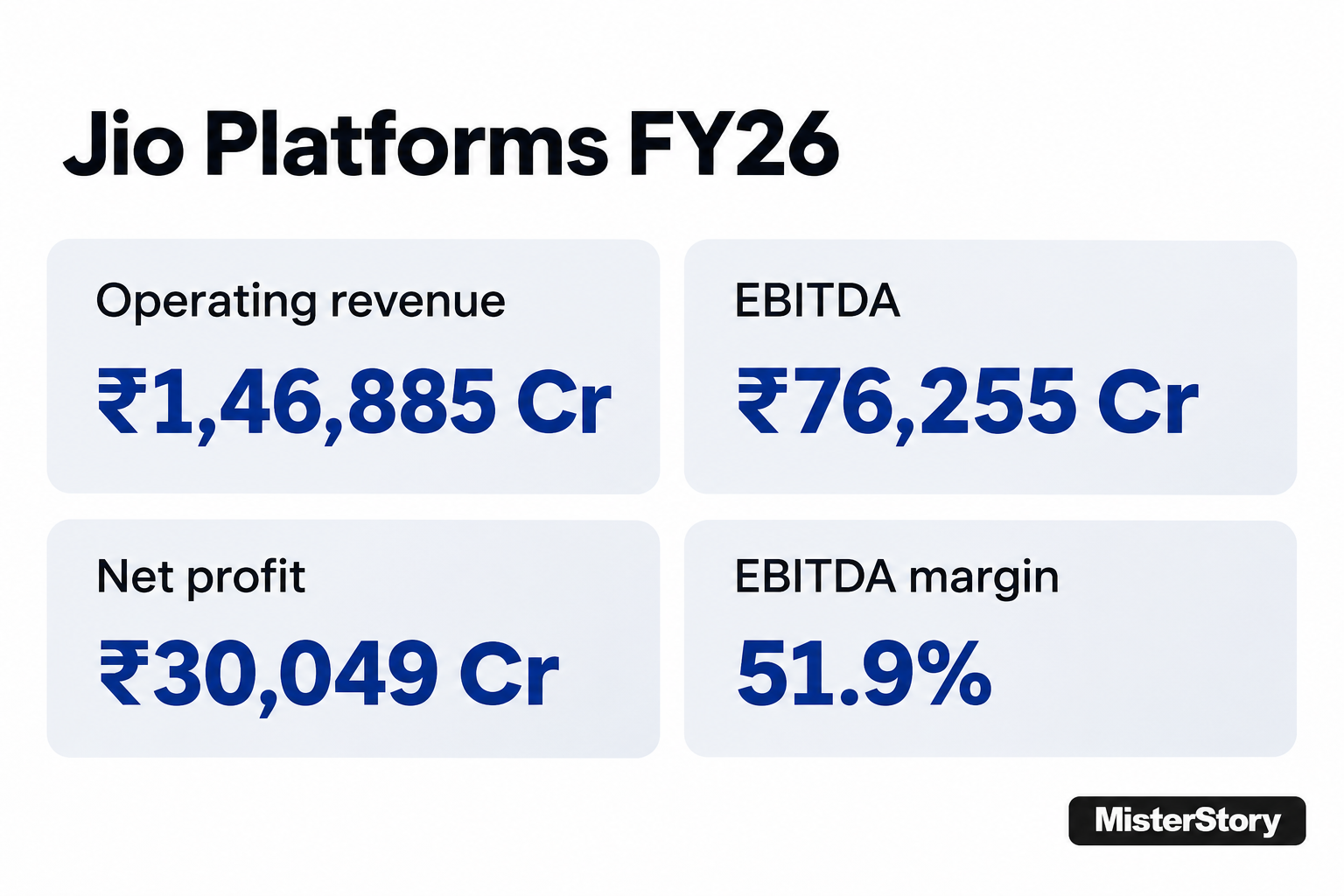
This illustrates operating leverage: as more customers use infrastructure that has already been built, revenue can grow faster than some operating costs. However, EBITDA excludes depreciation, financing costs and taxes, so it does not measure the full cost of building and maintaining a telecom network.
From Free Internet to India's Largest IPO
On 28 October 2026, Jio Platforms listed on the stock market after completing a ₹30,188 crore IPO, India's largest at the time. Its market capitalisation crossed ₹13 lakh crore on its first trading day, making it India's second-most valuable listed company at that point and placing it firmly among the top five.
At a market value of ₹13 lakh crore, Jio was valued at roughly 43 times its FY26 net profit. That multiple reflects expectations about future earnings, not just the value of its existing subscriber base. Investors were also considering opportunities in home broadband, enterprise connectivity and digital services.
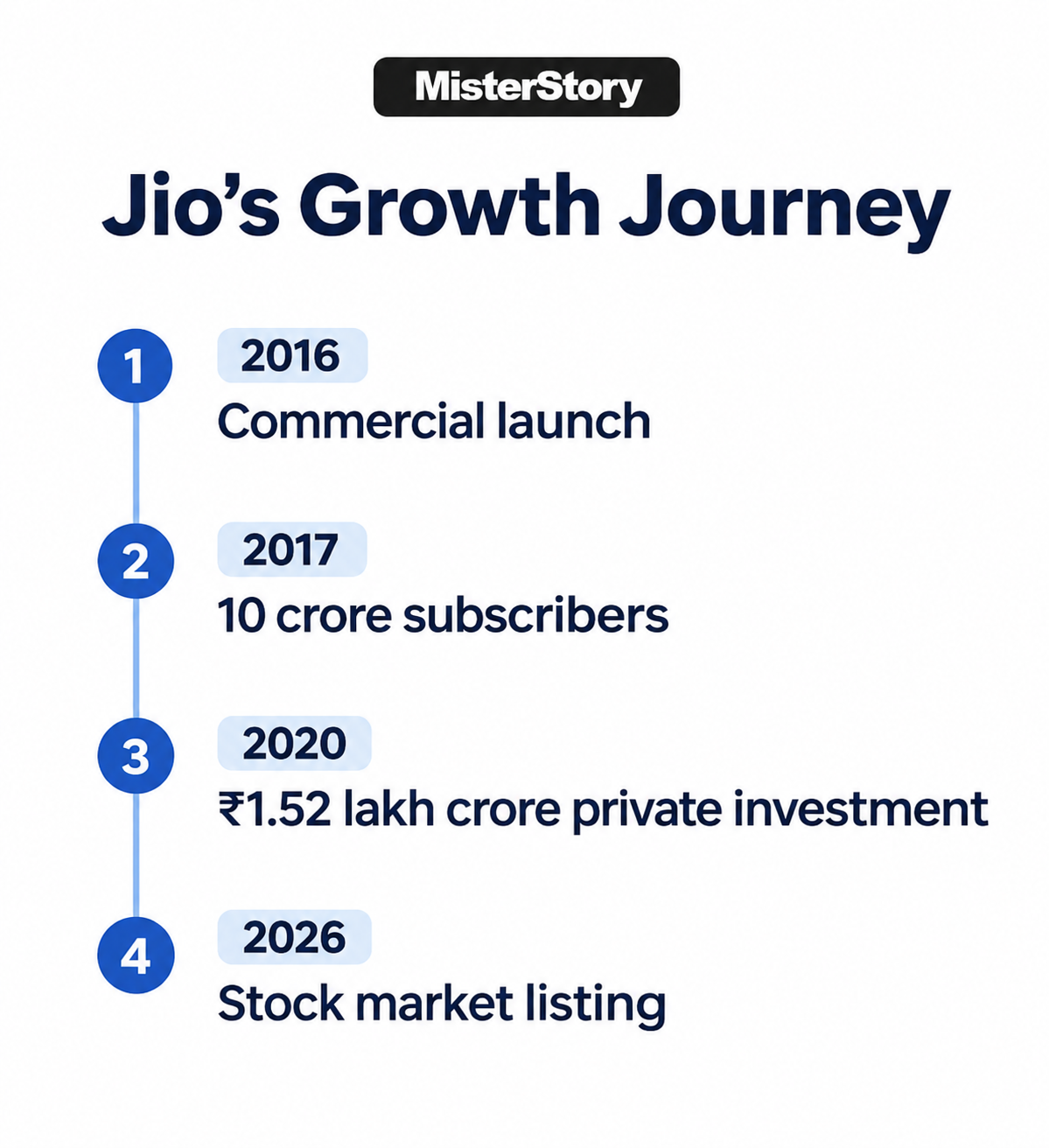
The listing completed an important stage of Reliance's investment journey: build the infrastructure, establish demand, attract private capital and eventually give public investors access to the business. The IPO itself should not be confused with the market value of the entire company.
Where Does Jio Stand Today?
By September 2026, Jio had 30 crore 5G customers and 3 crore home broadband connections. Average monthly revenue per connectivity customer was ₹218.80, while monthly data consumption reached 44.2 GB per customer. Quarterly operating revenue was ₹40,475 crore, with EBITDA of ₹21,879 crore and an EBITDA margin of 54.1%.
Compared with the same quarter a year earlier, operating revenue grew 11.4% and EBITDA grew 16.6%. Jio's next opportunity is to increase the value of its customer relationships through higher usage, pricing and additional services. Its ability to do so while managing investment and competition will determine whether future earnings justify its valuation.
Why Jio's Strategy Is So Difficult to Replicate
Jio's success cannot be explained by free internet alone. Its five strategies supported one another: financial strength funded network capacity, capacity enabled affordable services, affordable devices expanded the potential market and customer growth helped spread infrastructure costs across a larger base.
This is a cost advantage driven by scale, not automatically a network effect. A larger customer base does not necessarily make every individual customer's connection more valuable, and network congestion can require additional spending.
The lesson is that a company can disrupt an established industry when its cost structure, financial resources and long-term strategy allow it to compete under different economic conditions from its rivals. Jio's willingness to invest before demand existed was as important as its decision to lower prices.