How a ₹1 Candy Became a ₹750 Crore Brand: Pulse Case Study
What's covered
- Pulse Entered a Market Dominated by 50-Paise Candies
- The Masala Centre Became the Product
- Distribution Came Before Advertising
- DS Group Already Had a Distribution Advantage
- The Real Business Model Is Volume
- Why ₹750 Crore Does Not Necessarily Mean ₹750 Crore of Revenue
- Pulse Is Now a Significant Part of the Category
- What Pulse Actually Got Right
Pulse sells for just ₹1. Yet in FY25, the candy crossed ₹750 crore in sales at consumer price and captured roughly 19% of India's approximately ₹4,000 crore hard-boiled candy market.
That implies something remarkable: around 750 crore Pulse candies were sold during the year.
The success of Pulse was not simply about selling a cheap product to a large population. DS Group combined an unusual product, an existing distribution network and enormous unit volumes to build one of India's biggest candy brands.
Pulse Entered a Market Dominated by 50-Paise Candies
When DS Group launched Pulse in 2015, much of India's hard-boiled candy market still operated around the 50-paise price point.
Pulse entered at ₹1.
Charging twice the prevailing price could have made adoption difficult. Instead of competing by becoming cheaper, DS Group tried to give consumers noticeably more.
Pulse was larger than many competing candies and combined a raw-mango-flavoured outer candy with a tangy masala powder filling inside.
The idea was based on a familiar Indian taste: eating kachcha aam with salt and spices.
That small change made the product different from a conventional hard-boiled candy. Consumers first tasted the sweet and sour mango flavour before eventually reaching the stronger masala centre.
Pulse was therefore not really competing only on price. It was attempting to make ₹1 feel worth paying.
The Masala Centre Became the Product
Candy is a difficult category to differentiate. Most products are inexpensive, easy to imitate and purchased impulsively. A consumer standing at a shop counter can easily switch between brands.
Pulse created a feature that was easy to recognise and remember.
The powder-filled centre gave consumers a reason to specifically ask for Pulse instead of simply buying whichever candy was available.
This is an important part of low-ticket consumer businesses.
A product does not always need sophisticated technology to create differentiation. Sometimes changing the way a familiar product is consumed can be enough.
But having a good product was only one part of the story. DS Group also needed to make sure people could find it almost everywhere.
Distribution Came Before Advertising
Pulse reportedly crossed around ₹50 crore in sales within its first six months and reached approximately ₹100 crore within eight months.
Much of this early growth came before a major advertising campaign.
DS Group's approach was unusual because it focused first on getting Pulse into shops. Management wanted the product to be available across a large proportion of relevant retail outlets before spending heavily on television advertising.
The logic was straightforward.
Imagine seeing an advertisement for a ₹1 candy and walking into the nearest shop only to discover that the retailer does not stock it. The desire to buy the product may disappear within minutes.
For an expensive product, a customer may search online, travel to another store or wait for availability.
Very few people will do that for a ₹1 candy. That means distribution can be as important as brand awareness. For impulse products, availability is effectively part of the product.
DS Group Already Had a Distribution Advantage
Pulse also benefited from something that a new confectionery company would have found difficult to replicate.
DS Group already had a large distribution network. Its existing products, including Rajnigandha and Pass Pass, had given the company deep relationships with distributors, paan shops and small retailers across India.
Those outlets were particularly useful for Pulse.
Candy is often bought while a customer is already standing at the counter. There is little planning involved and very little financial decision-making.
A ₹1 product sitting next to the cash counter can therefore generate millions of tiny purchase decisions.
DS Group could introduce Pulse through a network that had already been built for other products rather than creating distribution from scratch.
Today, the group's overall distribution network reaches more than 35 lakh retail outlets.
This demonstrates one reason large FMCG companies frequently expand into adjacent categories.
Once the distribution infrastructure already exists, putting another product onto the same retailer's shelf can be much easier than building an entirely new route to market.
The Real Business Model Is Volume
The most interesting part of Pulse becomes visible when you look at the mathematics.
FY25 Baseline
Pulse crossed ₹750 crore in FY25, holding roughly a 19% share of India's approximately ₹4,000 crore hard-boiled candy segment.
Because the standard candy still sells at ₹1, ₹750 crore at consumer price corresponds to roughly 750 crore candies.
That is approximately: 2.05 crore candies every day or around 8.6 lakh candies every hour averaged across an entire year.
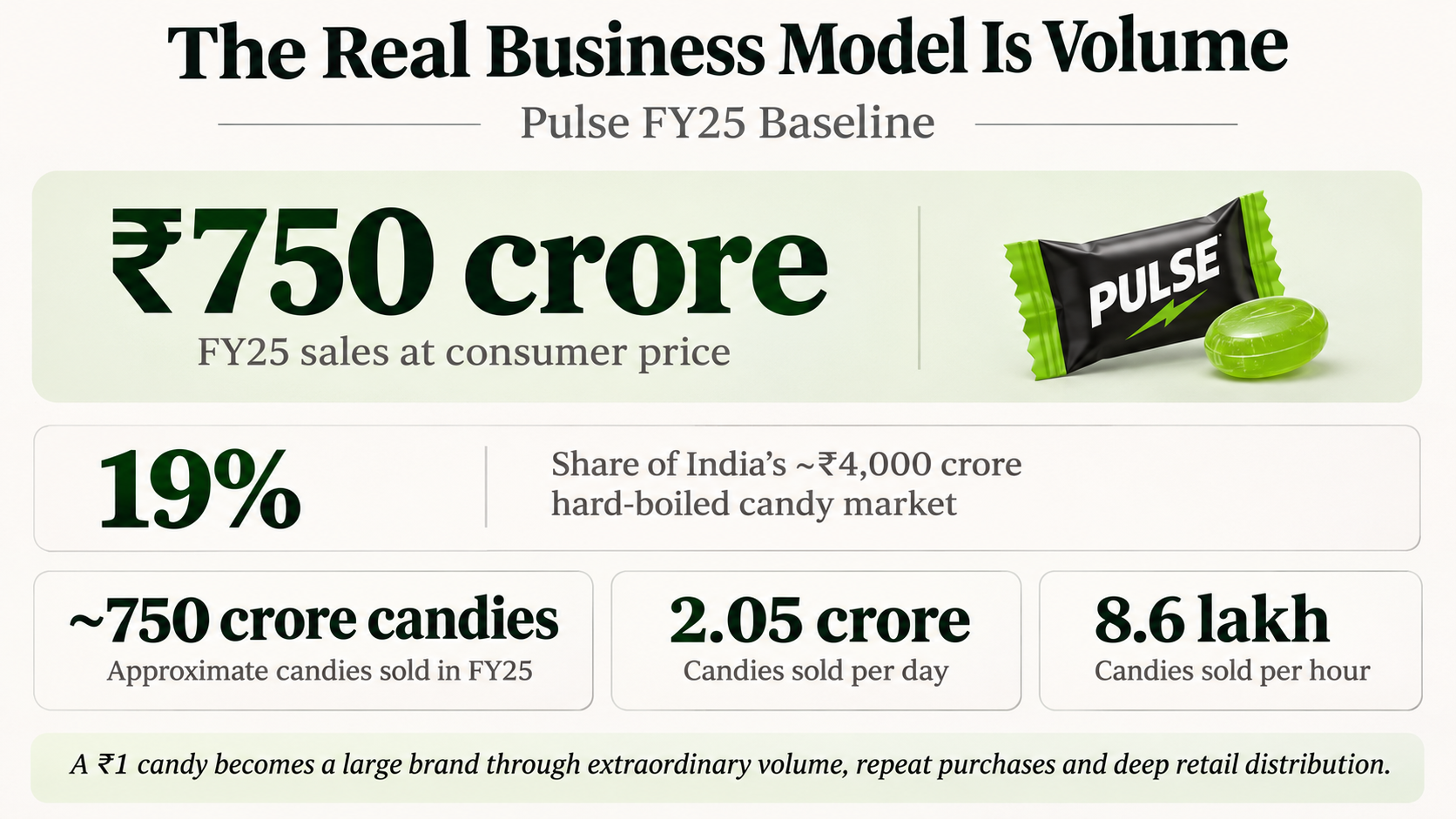
That scale explains how an extremely inexpensive product can become a large brand. A ₹1 candy cannot generate ₹750 crore by earning a lot from each customer.
It has to generate an extraordinary number of transactions. This is the central economics of many low-ticket FMCG products. The individual purchase barely matters.
What matters is whether millions of people repeatedly make that purchase across millions of retail locations.
Why ₹750 Crore Does Not Necessarily Mean ₹750 Crore of Revenue
There is one important distinction. DS Group describes Pulse as having crossed ₹750 crore at consumer price.
That should not automatically be interpreted as ₹750 crore of revenue recognised by DS Group.
The price paid by the consumer also has to support distributors, retailers and other parts of the supply chain.
So ₹750 crore is better understood as the value of Pulse sold to consumers at retail prices rather than necessarily DS Group's net reported revenue from the brand.
The distinction matters because retail value and company revenue are often used interchangeably when discussing consumer brands even though they are not always the same number.
Source: DS Group
Pulse Is Now a Significant Part of the Category
Pulse's scale is no longer simply the result of a successful product launch. With roughly 19% market share, the brand now accounts for close to one-fifth of India's hard-boiled candy segment.
The company has also said Pulse has been growing at around 15% annually in recent years, faster than the broader category's roughly 9% growth.
DS Group is now targeting the next milestone: turning Pulse into a ₹1,000 crore brand.
Future growth can come from more than selling additional raw-mango candies.
The company has expanded Pulse into other flavours and formats, while continuing to experiment with products that use the same sweet, sour and spicy positioning.
That matters because once a brand has already established distribution and consumer recognition, launching additional products under the same name becomes easier.
What Pulse Actually Got Right
Pulse's success looks simple in hindsight. Launch an inexpensive candy, distribute it widely and sell billions of units.
But each piece reinforced the others. The masala centre gave consumers a reason to remember the product.
The ₹1 price kept the purchase inexpensive enough to remain impulsive.
DS Group's existing distribution network ensured the product was available when consumers wanted it.
And once that network reached sufficient scale, billions of ₹1 transactions turned into hundreds of crores of consumer sales.
Pulse therefore offers a useful lesson about Indian FMCG. A product does not need a high selling price to become a large business.
Sometimes the larger advantage is being inexpensive enough for almost anyone to buy, distinctive enough for them to remember and distributed widely enough to be available whenever they want it.