Matters.AI Raises ₹115 Crore to Expand Its AI-Powered Data Security Business
What's covered
- Inside Matters.AI's ₹115 Crore Funding Round
- What Does Matters.AI Do?
- How Does Matters.AI's Technology Work?
- Why AI Is Creating New Data Security Challenges
- Matters.AI's Platform Is Used Across More Than 50 Organisations
- How Matters.AI Plans to Use the Funding
- The Bigger Business Opportunity for Matters.AI
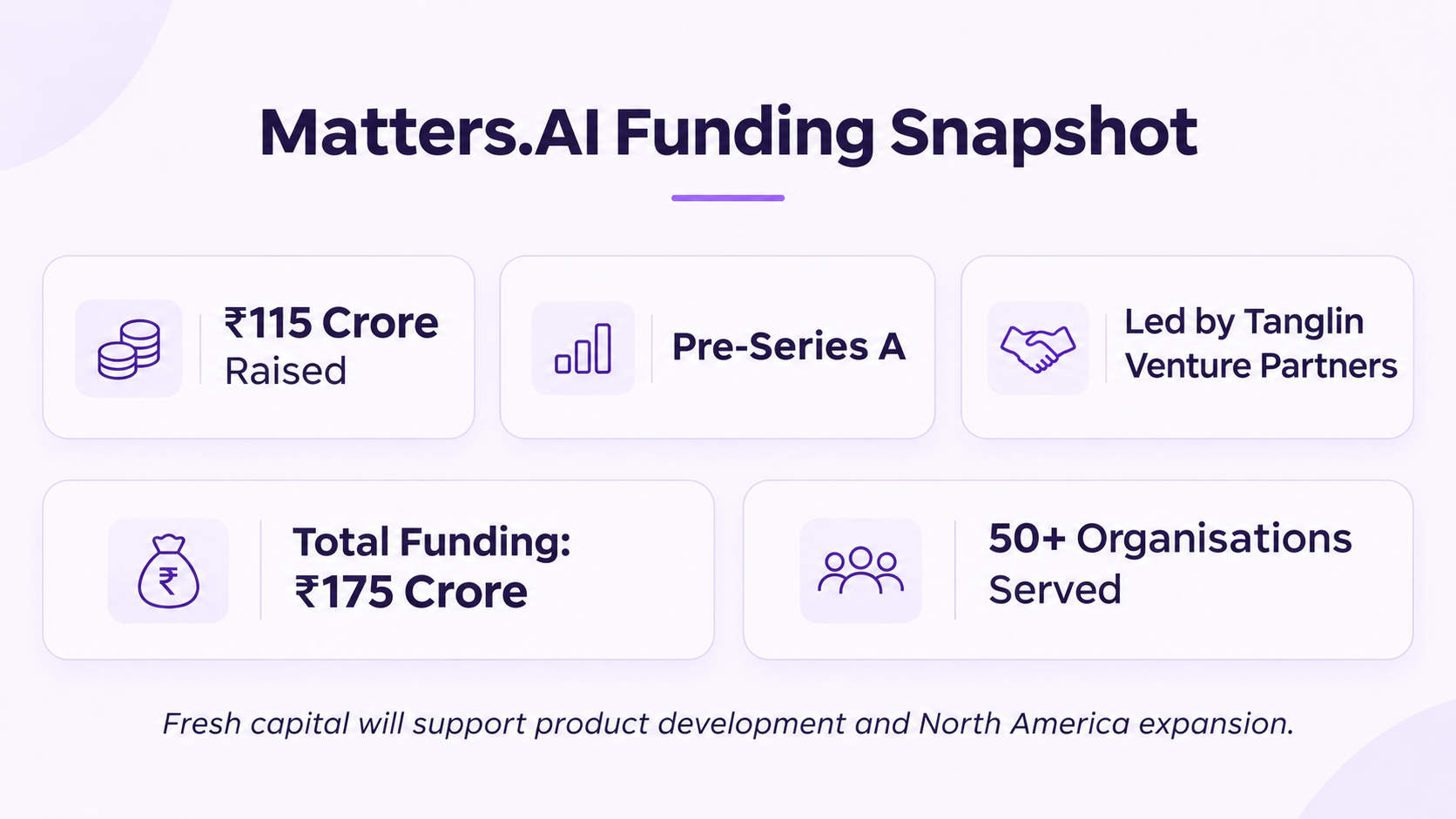
Bengaluru-based cybersecurity startup Matters.AI has raised ₹115 crore ($12 million) in a pre-Series A funding round led by Tanglin Venture Partners. The investment takes the company's total funding to approximately ₹175 crore ($18.25 million). Matters.AI develops software that helps businesses identify sensitive information, monitor how it is being used and prevent unauthorised access or data leaks. The company plans to use the fresh capital to improve its AI-powered security platform and expand its business in North America.
Inside Matters.AI's ₹115 Crore Funding Round
The funding round was led by Tanglin Venture Partners, with participation from IIFL Fintech Fund, Piper Serica's Bharat Tech Fund, Foster Ventures and Tetration Ventures.
Existing investors Kalaari Capital and Endiya Partners also participated in the round, continuing their support for the company.
Matters.AI previously announced a ₹55 crore ($6.25 million) seed funding round in October 2025, backed by Kalaari Capital and Endiya Partners.
The latest investment brings its cumulative funding to approximately ₹175 crore.
Regulatory filings reviewed before the company's funding announcement indicated a round of approximately ₹110 crore. Based on those filings, Matters.AI was estimated to have a post-money valuation of around ₹447 crore. The company has not independently confirmed this valuation.
Tanglin Venture Partners was expected to invest approximately ₹48 crore, making it the largest investor in the latest round.
What Does Matters.AI Do?
Matters.AI is an enterprise data security company founded by Keshava Murthy and Harsh Sahu. It develops software that helps organisations protect confidential information across their computer systems, cloud platforms and applications.
Large companies store enormous amounts of sensitive information, including customer records, financial transactions, employee details and internal business documents.
However, this information is rarely stored in one place. A bank, for example, might keep customer details in a database, loan documents on cloud servers and internal reports in applications used by employees.
This creates a difficult problem for cybersecurity teams. They must understand where sensitive information is stored, who can access it and whether anyone is using it in an unauthorised manner.
Matters.AI addresses this problem through a platform that brings several data security functions together.
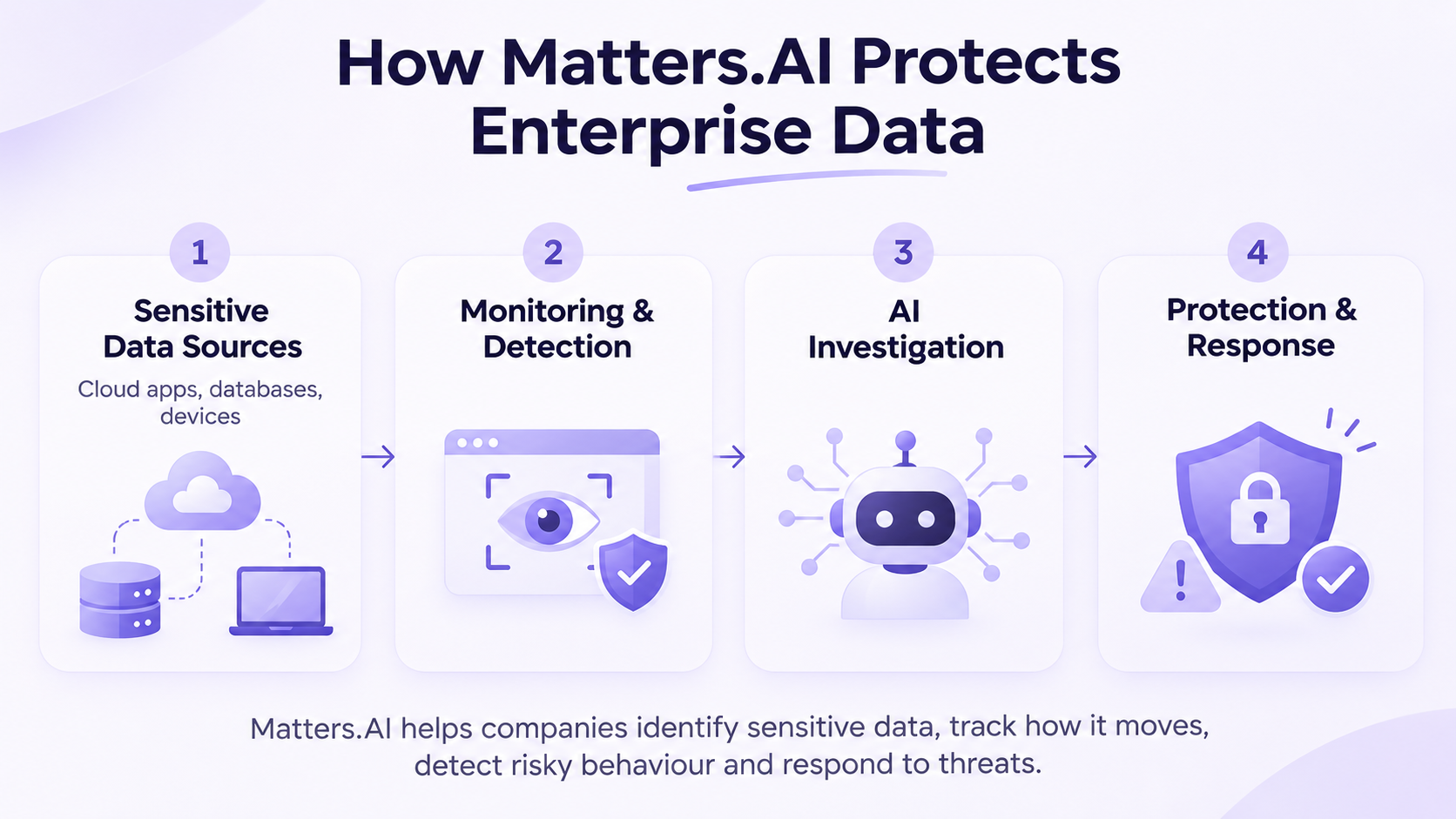
Its technology helps companies discover sensitive information, classify it according to its importance, monitor its movement and detect suspicious activity.
The company describes its platform as an AI Security Engineer for Data, reflecting its ambition to automate work that would otherwise require human cybersecurity professionals.
How Does Matters.AI's Technology Work?
Traditional data security systems often rely on predefined rules. For example, a company might configure its security software to flag an employee who tries to transfer a file containing customer account numbers outside the organisation.
However, these systems can generate large numbers of alerts, including warnings about legitimate activities. Security teams must then investigate which alerts represent actual threats.
Matters.AI attempts to improve this process by using artificial intelligence to understand the information being accessed and the circumstances surrounding each activity.
Its platform focuses on three connected functions.
First, it identifies sensitive information. The software scans connected systems to find confidential data, even when that information is spread across different applications and storage locations.
Second, it tracks how information moves. The platform monitors where data originates, which systems access it and how it travels across an organisation. This process is known as data lineage.
Third, it detects and investigates suspicious behaviour. Rather than relying entirely on fixed rules, Matters.AI uses information about data, users and activity patterns to identify potential security risks.
For example, an employee downloading a financial report as part of their regular work may be considered normal. However, an unusual attempt to transfer large amounts of confidential information to an external location could require further investigation.
Matters.AI is developing capabilities that can investigate such incidents and take corrective action based on an organisation's security policies.
The objective is to reduce the amount of manual work required from cybersecurity teams while helping companies respond to potential data leaks more quickly.
Why AI Is Creating New Data Security Challenges
The growing adoption of artificial intelligence is making enterprise data security more complicated.
Companies are increasingly using AI applications to analyse documents, generate reports, answer employee questions and automate business processes.
Some organisations are also introducing AI agents, which are software systems capable of carrying out tasks with limited human involvement.
These applications may need access to confidential company information to function properly.
For example, an AI agent used by a financial institution might access customer records, transaction histories and internal reports to prepare an analysis.
The security challenge is no longer limited to whether an employee has permission to open a particular file. Companies must also understand how AI applications use information after receiving access.
An AI system could potentially expose confidential data through an external application, retrieve more information than necessary or transfer sensitive material to an unauthorised destination.
Matters.AI is developing technology to monitor these interactions and identify situations where sensitive information may be misused.
This creates an opportunity for cybersecurity companies that can provide visibility across employees, applications and AI systems.
However, successfully automating security decisions also introduces challenges. A system that incorrectly blocks legitimate activity can disrupt business operations, while one that fails to recognise a genuine threat can leave sensitive information exposed.
The accuracy and reliability of these systems will therefore be important factors in enterprise adoption.
Matters.AI's Platform Is Used Across More Than 50 Organisations
Matters.AI says its technology has been deployed across more than 50 organisations, including financial institutions, stockbroking firms, asset managers, retailers and digital media companies.
These industries handle significant amounts of confidential information and often face strict requirements around data protection.
Financial institutions are particularly relevant customers because they regularly process sensitive customer details, financial records and transaction information.
The company's website also features testimonials from security executives at businesses including PayU, Groww, CRED and Credit Saison.
Enterprise adoption is an important development for Matters.AI because cybersecurity products must generally be tested and integrated with existing systems before organisations use them to protect critical information.
However, the company has not publicly disclosed its annual revenue, recurring subscription income or the commercial value of these deployments. Therefore, the reported number of organisations cannot be used on its own to estimate the size or growth of its business.
How Matters.AI Plans to Use the Funding
Matters.AI plans to direct the new capital towards product development and international expansion.
A major part of the investment will support research and development in data lineage, autonomous security investigations, endpoint and browser intelligence, and protection against sensitive data misuse by AI agents.
Endpoint intelligence involves monitoring devices such as employee laptops and workstations, while browser intelligence helps security systems understand activities taking place through web applications.
These capabilities are important because sensitive information can move through several channels before reaching an external destination.
The company also plans to strengthen its presence in North America, beginning with senior leadership appointments and investment in its sales organisation.
Expanding internationally could allow Matters.AI to reach larger enterprise customers and compete in a broader cybersecurity market.
However, North American expansion will also expose it to established cybersecurity providers with substantial financial resources, existing customer relationships and wider product portfolios.
The Bigger Business Opportunity for Matters.AI
Matters.AI is entering a market where the problem of protecting enterprise information is becoming more complicated.
Earlier generations of cybersecurity software largely focused on protecting networks, devices and applications from unauthorised access.
Modern businesses must also protect information that continuously moves between cloud services, employee devices, external applications and AI systems.
This is why Matters.AI is trying to combine data discovery, monitoring, risk detection and automated response within a single platform.
For customers, the potential benefit is simpler security management. Instead of using separate tools to locate sensitive data, monitor its movement and investigate incidents, organisations could manage more of these activities through one system.
From a business perspective, the opportunity is to become a core part of an enterprise's data security infrastructure.
The company has already reported deployments across more than 50 organisations and attracted approximately ₹175 crore in funding. These are encouraging indicators of investor interest and early market adoption, but they do not yet establish the commercial scale of its business.
Its next stage of growth will depend on whether it can convert enterprise deployments into sustainable revenue, demonstrate reliable automated security responses and compete effectively in international markets.
The larger bet behind Matters.AI is that cybersecurity will increasingly move beyond identifying threats towards systems that can understand, investigate and respond to them automatically. The ₹115 crore investment gives the company additional resources to pursue that opportunity, but its long-term success will depend on how effectively its technology performs in real business environments.