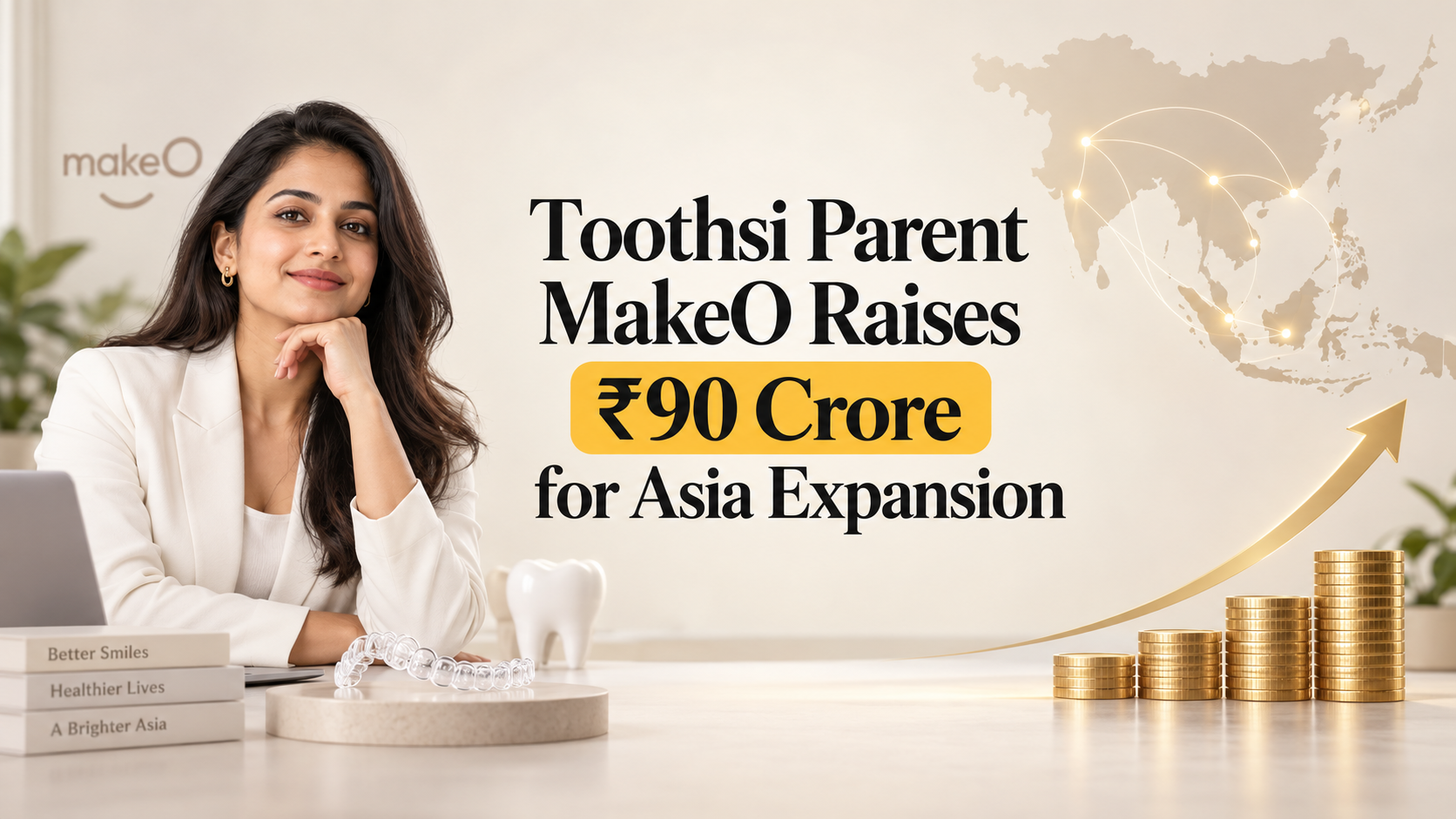
Toothsi Parent MakeO Raises ₹90 Crore to Expand Across Asia
What's covered
MakeO, the Mumbai-based parent company of clear aligner brand Toothsi, has raised ₹90 crore in a funding round led by Singularity AMC. DSP Family Office, Genesis Ventures and Unispace Ventures also participated in the round. The company plans to use the money to expand its dental clinic network across India and Southeast Asia, strengthen its manufacturing capabilities and invest in technology.
The funding comes after MakeO's expansion into international markets through Singapore-based dental care company Zenyum. The combined business now has around 1,100 partner dentists across 10 countries, marking a significant shift from MakeO's earlier focus on the Indian market.
What Does MakeO Do?
MakeO is a dental and personal care company best known for Toothsi, which provides customised transparent aligners to straighten teeth. Unlike traditional metal braces, these aligners are removable and designed to gradually move teeth into the desired position.
The company was founded by Arpi Mehta, Pravin Shetty, Manjul Jain and Anirudha Kale. It started with the idea of making teeth-straightening treatments more accessible through technology, home consultations and a network of dental professionals.
MakeO later expanded into skin and hair treatments through Skinnsi, bringing different cosmetic and personal care services under one platform.
Its dental business combines online customer acquisition with physical consultations, treatment planning and manufacturing. Customers undergo a dental assessment, after which customised aligners are designed and manufactured for their treatment.
This model allows MakeO to participate in multiple stages of the customer journey, from the initial consultation to manufacturing the aligners and providing ongoing treatment support.
Where Will MakeO Use the ₹90 Crore?
A significant part of the funding will support MakeO's expansion of physical dental clinics across India and Southeast Asia.
Although Toothsi initially grew through a digital-first approach, dental treatments still require clinical examinations, professional supervision and follow-up appointments. Expanding its clinic network allows MakeO to serve customers who prefer in-person consultations while giving the company greater control over the treatment experience.
The company also plans to strengthen its manufacturing and technology facility in the Mumbai Metropolitan Region. The facility produces customised dental aligners for customers in India and international markets.
MakeO is also looking at acquisitions of dental clinics and aligner businesses. Rather than opening every new clinic itself, buying existing businesses could help it enter new cities and markets with established teams and customer relationships.
Another priority is integrating Zenyum's operations with its Indian business, particularly in manufacturing, technology and clinical services.
How Zenyum Changed MakeO's Business
One of MakeO's most important developments in 2026 was its combination with Singapore-based Zenyum, a dental care company operating across several Asian markets.
Zenyum sells clear aligners and other oral care products and works with local dental professionals to provide treatment. Its presence in markets such as Singapore, Malaysia, Vietnam, Taiwan, Hong Kong and Japan gives MakeO a much broader international network.
Together, MakeO and Zenyum have around 1,100 partner dentists across 10 countries. The combined group can use MakeO's manufacturing and treatment-planning capabilities to support dental services across multiple markets.
The company has also expanded through acquisitions within India. In 2025, MakeO acquired Apple Dental, a chain of 20 clinics in Andhra Pradesh and Telangana, for approximately ₹10.9 crore through a cash-and-stock transaction.
These acquisitions show how MakeO's strategy has evolved. Instead of depending only on selling aligners directly to consumers, the company is building a wider dental care network that combines manufacturing, technology and physical clinics.
How Does MakeO Make Money?
MakeO's main dental business earns revenue by providing clear aligner treatments to customers. A customer pays for a treatment plan that includes customised aligners, clinical assessment and professional support.
The company designs and manufactures aligners using digital scans and treatment-planning technology. By handling manufacturing and treatment planning, MakeO can potentially retain more value within its business rather than relying entirely on outside suppliers.
Its expanding clinic network also creates opportunities to provide other dental services beyond teeth alignment. Through Zenyum, the group has a presence in additional oral care products and international dental markets.
However, revenue does not translate directly into profit. The business must pay for manufacturing, dental professionals, clinics, technology, marketing and customer support. Expanding physical operations can also increase fixed costs, making clinic utilisation and treatment volumes important factors in profitability.
What Do MakeO's Financials Reveal?
MakeO's historical financial performance shows why its expansion strategy matters.
In FY25, the company reported revenue of approximately ₹161 crore, compared with ₹182.8 crore in FY24. This represented a decline of around 11.9%. It also reported a net loss of approximately ₹91.6 crore in FY25.
However, the company's latest reported position looks different following its combination with Zenyum.
MakeO says the combined business has crossed ₹500 crore in revenue and achieved EBITDA profitability earlier in 2026. EBITDA profitability means the business is generating a positive operating result before accounting for interest, taxes, depreciation and amortisation. It does not necessarily mean the company is making a net profit.
It is also important to distinguish between MakeO's earlier financial results and the latest combined figures. The FY25 revenue relates to MakeO's historical business, while the ₹500 crore figure includes the wider group following its expansion and combination with Zenyum. The two numbers therefore cannot be used to calculate organic revenue growth.
The company now aims to double its revenue over the next two to three years, supported by international expansion, additional clinics and a larger treatment network.
What Could Challenge MakeO's Expansion?
Dental care is a large but fragmented market, with independent clinics, established dental chains and specialised aligner providers competing for customers.
MakeO's biggest challenge will be expanding its operations without allowing costs to rise faster than revenue. Opening or acquiring clinics requires investment in infrastructure, dental professionals and ongoing operations. These investments need sufficient patient demand to become financially sustainable.
International expansion adds another layer of complexity because dental regulations, pricing, consumer preferences and healthcare systems differ across countries.
The company will also need to integrate acquired businesses while maintaining consistent treatment quality across its expanding network.
Its manufacturing capabilities and technology could provide an advantage, but the financial benefits will depend on how efficiently MakeO can use its growing network to attract and serve customers.
What This Funding Means for MakeO
MakeO's ₹90 crore funding round represents another step in its transition from an Indian clear aligner brand into a broader Asian dental technology business.
Its strategy combines centralised manufacturing and treatment planning with a growing network of clinics and dental professionals. If successful, this could allow MakeO to serve more customers across different markets without having to build every part of its operations independently.
However, the distinction between growth through acquisitions and growth within existing operations remains important. The company's earlier revenue decline and losses show that building scale alone does not guarantee a profitable business.
The next test for MakeO will be whether its expanded network, manufacturing operations and international presence can deliver sustainable revenue growth while maintaining profitability. That will ultimately determine whether the latest funding translates into a stronger dental care business.