Why Zudio Built 1,000 Stores Instead of Going Online
What's covered
- Zudio Has Built Scale Through Physical Stores
- A ₹499 T-Shirt Is Harder To Sell Online Than It Looks
- Online Fashion Has Another Problem: Returns
- A Zudio Store Also Works Like Advertising
- Zudio's Product Strategy Is Built For Browsing
- One Thousand Stores Change The Online Equation
- But 1,000 Stores Create A New Problem
- Zudio Is Not Against E-Commerce
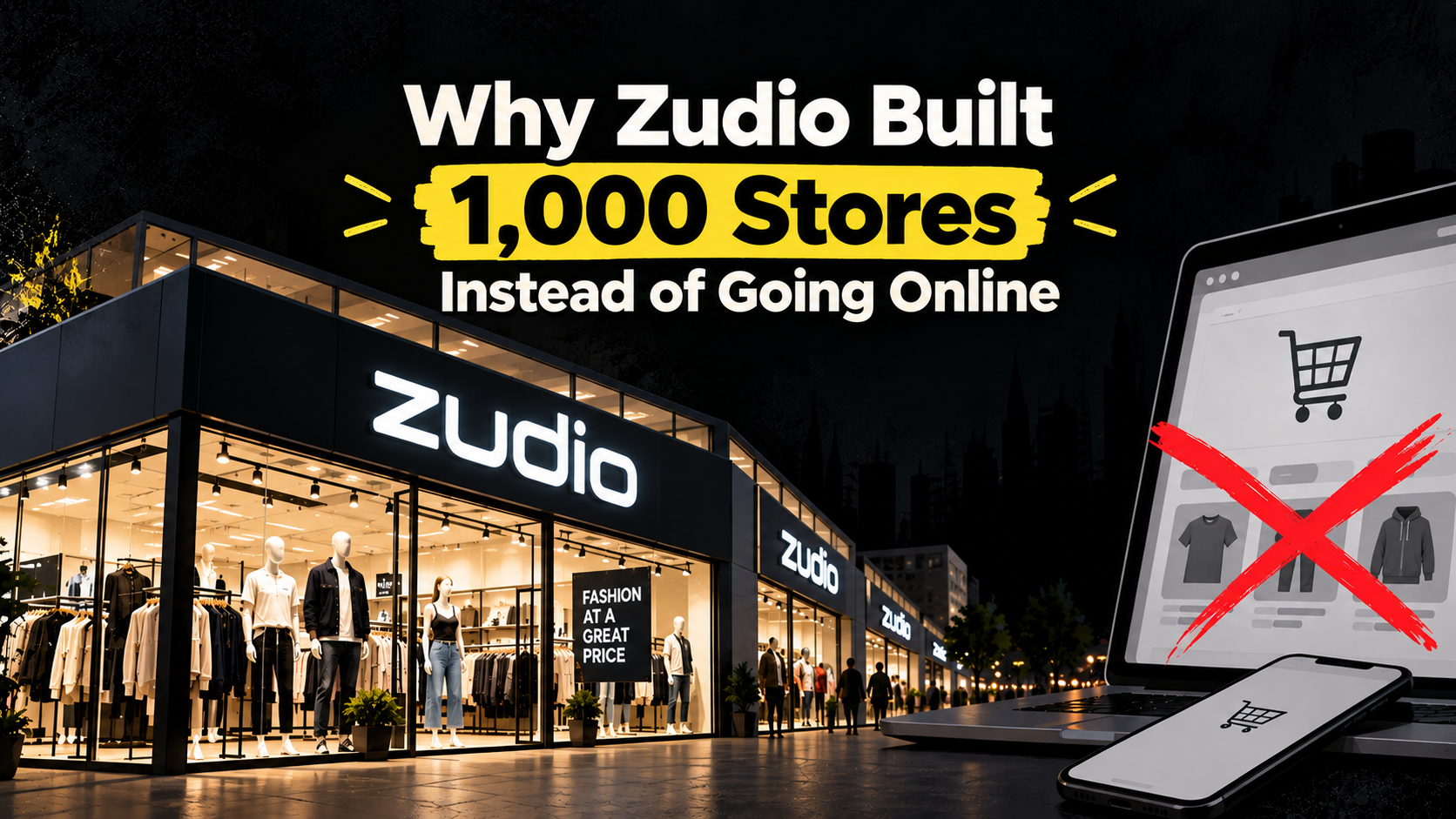
Zudio has crossed 1,000 stores in India, an unusual milestone for a fashion brand that has largely stayed away from selling online.
At a time when fashion retailers are investing heavily in apps, warehouses and home delivery, Zudio has taken a different route. Trent, the Tata Group company behind Zudio, has kept putting physical stores closer to customers.
That does not appear to be because Zudio missed the e-commerce opportunity. It is largely about economics.
When many of your products cost only a few hundred rupees, getting customers into a store can make more sense than delivering each T-shirt individually to their homes.
Zudio Has Built Scale Through Physical Stores
Zudio was launched by Trent as a value-fashion format aimed at young and price-conscious Indian shoppers. Its proposition is simple: regularly changing fashion at prices that remain accessible to a mass-market customer.
Many Zudio products are priced below ₹999. The scale is already enormous. Zudio sold around 350 million items in the last year, according to the Financial Times. That works out to almost one item for every four people in India.
Instead of using e-commerce to spread this model across India, Trent has largely expanded it through stores.
Zudio crossed 1,000 stores in 2026, after starting only around a decade ago. Trent continued expanding even as consumer demand remained uneven. In Q2 FY27, Trent's standalone revenue grew 23% year-on-year, helped by continued store additions and improving sales productivity.
There is an important difference between this and the way many modern fashion brands grow.
Usually, if a retailer does not have a store in your city, it can reach you through its website.
Zudio has largely done the reverse.
It keeps taking the store closer to the customer.
To understand why, start with something as simple as a ₹499 T-shirt.
A ₹499 T-Shirt Is Harder To Sell Online Than It Looks
Imagine Zudio sells a T-shirt for ₹499.
The retailer first has to pay to design or source the product, move it through its supply chain and keep sufficient inventory available.
If that T-shirt is sold online, another layer of costs appears.
Someone must pick the product from a warehouse, package it, process the order and transport it to an individual customer's house. If the customer sends it back, part of that journey happens again in reverse.
The problem is that delivery does not become proportionately cheaper just because the product itself is cheap.
A ₹100 fulfilment and logistics cost would equal 20% of a ₹500 order but only around 3% of a ₹3,000 order.
That example is illustrative rather than Zudio's actual fulfilment cost, but it shows why low average selling prices make online economics much harder.
Zudio sits firmly at the lower end of fashion pricing. The Financial Times reported that the company sells trend-led clothing largely below ₹999 and has even maintained entry price points such as ₹199 for some T-shirts.
Yet the underlying retail economics appear strong. Noel Tata has said Trent's fashion business generates gross margins of roughly 44–45%. Maintaining those margins while keeping prices low requires tight control over sourcing, inventory and distribution.
Adding expensive last-mile delivery and returns to every order would make that equation more difficult.
A store changes the equation.
Trent transports hundreds or thousands of pieces to one location. Customers then come to that location, select what they want and carry the products home themselves.
Instead of Zudio solving the final kilometre separately for every shopper, thousands of shoppers complete that part of the journey themselves.
Online Fashion Has Another Problem: Returns
Delivery is only half the issue.
Fashion is one of the hardest categories to sell online because customers do not know exactly how something will look or fit until they wear it.
Recent industry estimates put return rates in Indian online fashion at more than 20–25% in many categories, while some fast-fashion industry estimates place returns as high as 30–40%.
Historical Redseer research found fashion had the highest cancellation and return rates among major Indian e-commerce categories, with 37–42% of orders being cancelled or returned at the time of its study. The exact industry rate has changed since then, but the structural problem remains.
This matters because a returned T-shirt does not simply move back into inventory at zero cost.
The retailer may need to arrange reverse shipping, inspect the product, process a refund, repack it and make it available for sale again.
For Zudio, the physical store shifts much of this decision before the transaction.
A customer can touch the material, see the actual colour, try two sizes and decide which product fits before paying.
In e-commerce, the customer's home often becomes the fitting room.
At Zudio, the fitting room comes before checkout.
That simple difference can have a large impact when hundreds of millions of items are being sold.
Noel Tata has directly cited the inefficiency and high return rates of e-commerce as one reason Zudio has not rushed online.
A Zudio Store Also Works Like Advertising
The store does another job that is easy to overlook.
It attracts customers.
If Zudio opens on a busy high street, thousands of people repeatedly see the storefront. A customer who did not plan to buy clothes may walk inside, browse for ten minutes and leave with a ₹399 T-shirt or ₹799 pair of trousers.
That means the same store performs several functions.
It holds inventory, displays products, lets customers try them, completes the transaction and continuously advertises the Zudio brand to people passing by.
This is particularly important because Zudio is a discovery-led business.
Online-first fashion brands often need to spend repeatedly on Instagram, Google, influencers and marketplace advertising to bring shoppers to their websites. Customer acquisition becomes another variable that must be recovered from every order.
A good physical location works differently.
Trent pays for the location, but that location can generate traffic day after day. As long as enough shoppers enter and enough inventory gets sold, the economics can become attractive.
The store is therefore not simply an offline replacement for a website.
For Zudio, the store is simultaneously its distribution network, showroom and customer-acquisition engine.
Zudio's Product Strategy Is Built For Browsing
The model also fits the way people shop for inexpensive fashion.
A customer buying a specific smartphone usually starts with a clear requirement. They may compare models online and search for the exact device they want.
Fashion shopping can be far less planned.
Someone may enter Zudio just to look around and find a new top, pair of jeans or footwear at a price low enough to make the purchase easy to justify.
Zudio strengthens this behaviour by changing its assortment frequently.
The Financial Times reported that Zudio introduces new products every week and uses social-media trends to understand what younger customers are interested in.
That is an important distinction.
Zudio is not ignoring the internet.
It can use Instagram and other digital platforms to understand trends, watch customer behaviour and influence what reaches its stores.
It simply does not need the internet to be the place where most transactions happen.
Digital helps Zudio understand demand.
Physical stores capture it.
One Thousand Stores Change The Online Equation
An offline strategy has an obvious weakness.
Customers need to live close enough to a store.
If Zudio had only 50 stores across India, refusing to build a serious online channel would limit the size of its market. Millions of consumers could know the brand but have no practical way to shop there.
At 1,000 stores, that problem looks very different.
Every new location reduces the distance between Zudio and another group of consumers.
This is especially important because Zudio has expanded beyond India's largest metropolitan areas and into smaller cities. Trent sees young consumers moving from unorganised local fashion towards organised retail as a major long-term opportunity. Noel Tata has even spoken about the possibility of eventually reaching around 5,000 Zudio stores.
That ambition tells us a lot about Trent's thinking.
Many companies solve geographic reach through delivery.
Zudio is trying to solve it through physical density.
If the nearest Zudio moves from 50 kilometres away to five kilometres away, the need for Zudio to deliver a ₹499 product to that customer becomes much smaller.
At sufficient scale, the physical network itself starts performing the job that e-commerce would normally perform: making the brand accessible.
But 1,000 Stores Create A New Problem
This strategy has limits.
Opening stores creates fixed costs. Trent needs locations, employees, inventory, utilities and store infrastructure.
More importantly, the next Zudio store may not always create entirely new demand.
Imagine Zudio has two successful stores in one city and opens a third nearby. Some customers visiting the new store may be new to Zudio.
But others may simply move from one of the older locations. That is cannibalisation.
This is why store productivity matters more as the network becomes larger.
Recent Trent numbers provide an interesting signal. Analysts cited by Reuters noted that the decline in revenue per store had moderated significantly in Q2 FY27. Sales productivity declined by only around 1% year-on-year, compared with a decline of roughly 5% in the previous quarter.
That improvement was one reason investors responded positively to Trent's latest business update.
It suggests the company was able to keep adding stores while limiting the damage to sales productivity at existing locations.
The next phase will be harder.
Going from 100 stores to 500 stores gives Zudio access to many new markets. Going from 1,000 towards several thousand means Trent increasingly needs to find new locations without simply dividing the same customers between more outlets.
So the number investors should watch is not just the store count.
It is how much incremental business every new store actually creates.
Zudio Is Not Against E-Commerce
None of this means Zudio will never sell online.
Noel Tata has said the company has not permanently ruled out e-commerce. If the economics become attractive enough, there is no reason Zudio cannot eventually add it as another distribution channel.
But Trent does not need to build an online business simply because fashion retail is becoming digital.
Zudio has already found a model that matches its price points and customer behaviour.
It sold around 350 million items in a year without building its growth story around home delivery. Its network has now crossed 1,000 stores, while Trent continues to report double-digit revenue growth.
Those numbers make Zudio's offline strategy harder to dismiss as old-fashioned retail.
The physical store solves several problems at once. Customers can discover products, check quality, try clothes before buying and immediately take their purchases home. Zudio avoids much of the last-mile complexity that comes with delivering very low-priced products, while the store itself generates visibility and customer traffic.
That does not mean physical retail is always better than e-commerce.
It means Zudio has chosen the distribution system that fits its economics.
For a company selling hundreds of millions of low-priced fashion products, avoiding millions of individual delivery and return journeys can be a powerful advantage.
Zudio's 1,000-store milestone therefore represents more than aggressive expansion. It shows that in Indian value fashion, putting the store closer to the customer can sometimes be more valuable than putting the product on an app.